Showing posts with label unit study. Show all posts

Thursday, 14 March 2013

The start of a new adventure


For the most part of this term and beyond, our learning will mostly be based on The Travels of Marco Polo.


When I did the planning for this topic, I found that this can be turned into a cross-curricula, theme-based learning -- much like a unit study -- since it covers so many different areas: history, geography, science, maths, art, craft, music, food, and literature.  Hence, I shall be posting about our learning adventures and resources as we follow Marco Polo's journey to the East and back.

As this unit is going to be heavy on geography, I had Tiger work through the Marvelous Map Activities for Young Learners and Fun-to-Solve Map Mysteries to gauge his understanding of basic physical geography knowledge.
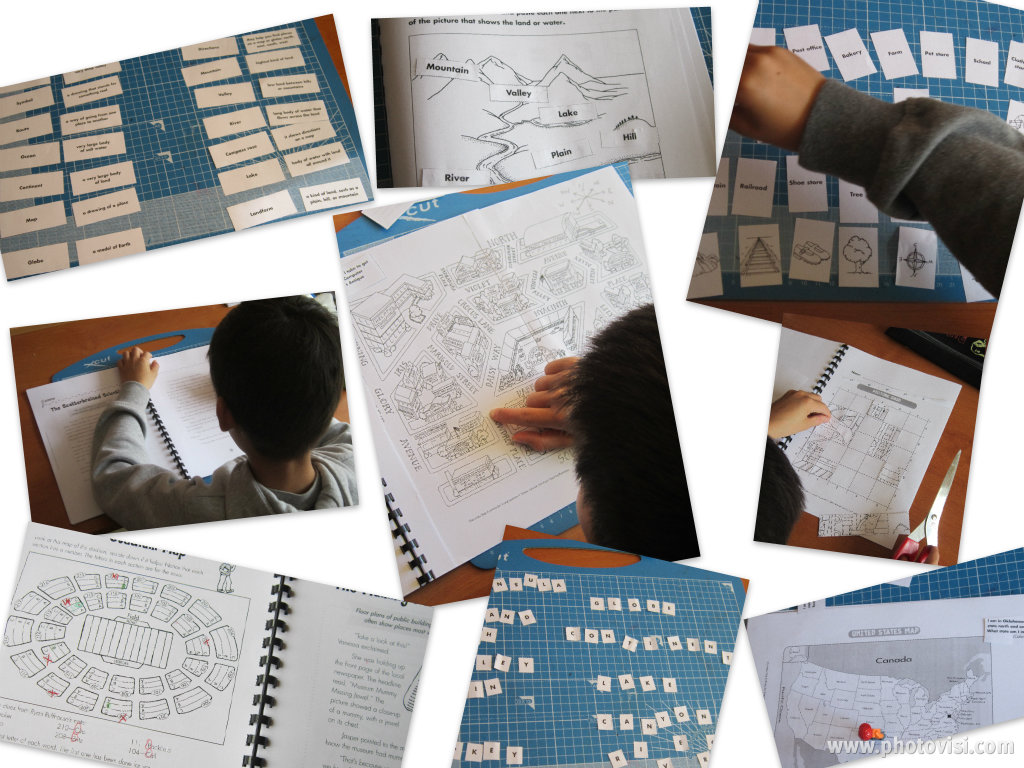

Until now geography was not our focus, even though we have been incorporating map work consistently as part of our history lessons, so I feel it is important for me to have an idea of how much Tiger already knows (or not) to plan our lessons effectively.  He flew through the first two books, but needed some help with Great Map Mysteries, which covers topics such as grid map, map scale, and time zones.

With the basics out of the way, we started getting an overview of Marco Polo and his travels by reading generically about him:


We also found the following documentary very useful to prepare us to join Marco Polo on his adventures:


There seems to be various maps around that show slightly different locations of Marco Polo's journey.  We have tried to cross-reference the various maps to arrive at our own conclusion as to the present-day equivalent of where he would have been.


So far, we've figured that his outbound journey was as follows:
Venice (Italy) --> Jerusalem --> Lebanon --> Constantinople (Turkey) --> Armenia --> Baghdad (Iraq) --> Persia (Iran) --> Herat (Afghanistan) --> Kashgar (Central Asia) --> Tibet --> Mongolia --> Khanbaliq (Beijing in China)

When Marco Polo was at the service of Kublai Khan, he made the following journey:
Khanbaliq (China) --> Myanmar (Burma) --> Java (Indonesia) --> Eli (India) --> Khanbaliq (China)

His homeward journey was:
Zaitan (Xiamen in China) --> Vietnam --> Malaysia --> Singapore -->  Sumatra (Indonesia) --> Ceylon (Sri Lanka) --> India --> Persia (Iran) --> Caucasus (Azerbaijan, Georgia) --> Constantinople (Turkey) --> Venice

Therefore, we will be studying the cultural and physical geography of the following countries/cities as we travel along with Marco Polo:
  1. Italy
  2. Jerusalem
  3. Lebanon
  4. Turkey
  5. Armenia
  6. Iraq
  7. Iran
  8. Afghanistan
  9. Kashgar
  10. Tibet
  11. Mongolia
  12. China
  13. Burma
  14. Vietnam
  15. Malaysia
  16. Singapore
  17. Indonesia
  18. Sri Lanka
  19. India

This post is linked up to:
1) Creative Kids Cultural Blog Hop #1
2) Great Book Lists and Literacy Projects for Kids
3) Hearts for Home Blog Hop #8
4) History and Geography Meme #66
5) Homeschool Mother's Journal: March 15, 2013
6) Hobbies and Handicrafts - March 15
7) Collage Friday - Making Hard Life Choices
8) TGIF Linky Party #67
9) Homeschool Review - March 15
10) Creative Learning Link Up #6
11) Weekly Wrap-Up: The One Where I Got to Go On a Retreat
12) Share it Saturday - St. Patrick's Day Features
13) The Sunday Showcase - 3/16/13
14) Hip Homeschool Hop - 3/19/13
15) Look What We Did!


Friday, 30 November 2012

Robin Hood

We have been working through Robin Hood this term, both as a book of literature as a part of our history (UK and World).  We have a few different versions of the story of Robin Hood, and the one that we have used for our literature study is the version by Howard Pyle.


For a start, we watched the following documentary to gain a broad overview of the character as interpreted by different sources (historians, Hollywood, etc):


We find that the unit study approach to be working well for us in this respect, so we are using the lapbook resources from Homeschool Share as our basis.  We work through the units slowly, taking our time to explore in depth the various suggested points.  Although Tiger has been working through the various lapbook pages, I am not too concerned about whether he eventually puts them into lapbook form - it would be great if he were to feel inclined to arrange the various pieces of information that we are saving in a file into a presentable format, but if he doesn't want to do that, it's not a big deal for me.  I am happy as long as he has been engaged in the learning process and can orally present what he has learnt.  The final output (lapbook) is a non-essential part of our process at the moment.


After that, we wanted to know whether the character is true or fictional:


One of the points brought up in the documentary above in ascertaining how true the character of Robin Hood really is, is the possibility of surviving in all seasons in an English forest.  This is an interesting point to consider, given the sheer dampness of forests most of the time, not to mention how often it would be raining.  Tiger and I spent a fair amount of time considering whether that would be possible, and what it would take to live in the forest for any length of time.  For this discussion, Tiger consulted his favourite survival book:


We were lucky to attend a talk on medieval English archers given by a very experienced and knowledgeable member of an archaeological club that Tiger belongs to.


In the two-hour talk, the man covered in great details:
  • the different types of bows used in medieval times;
  • the different materials used for bows and arrows;
  • the functions and designs of different bows and arrows;
  • the medieval yeomanry; and
  • the strength and distance covered by each type of bow and arrow.
The most common and formidable type of bow in England in the middle ages was the long bow, which was made from yew trees.  As part of the talk, we were shown an actual growing yew tree in an ancient Anglo Saxon churchyard a few yards away.  We not only saw the yew tree, we were also cautioned about it being poisonous (branches, leaves, and the pip of its berries).


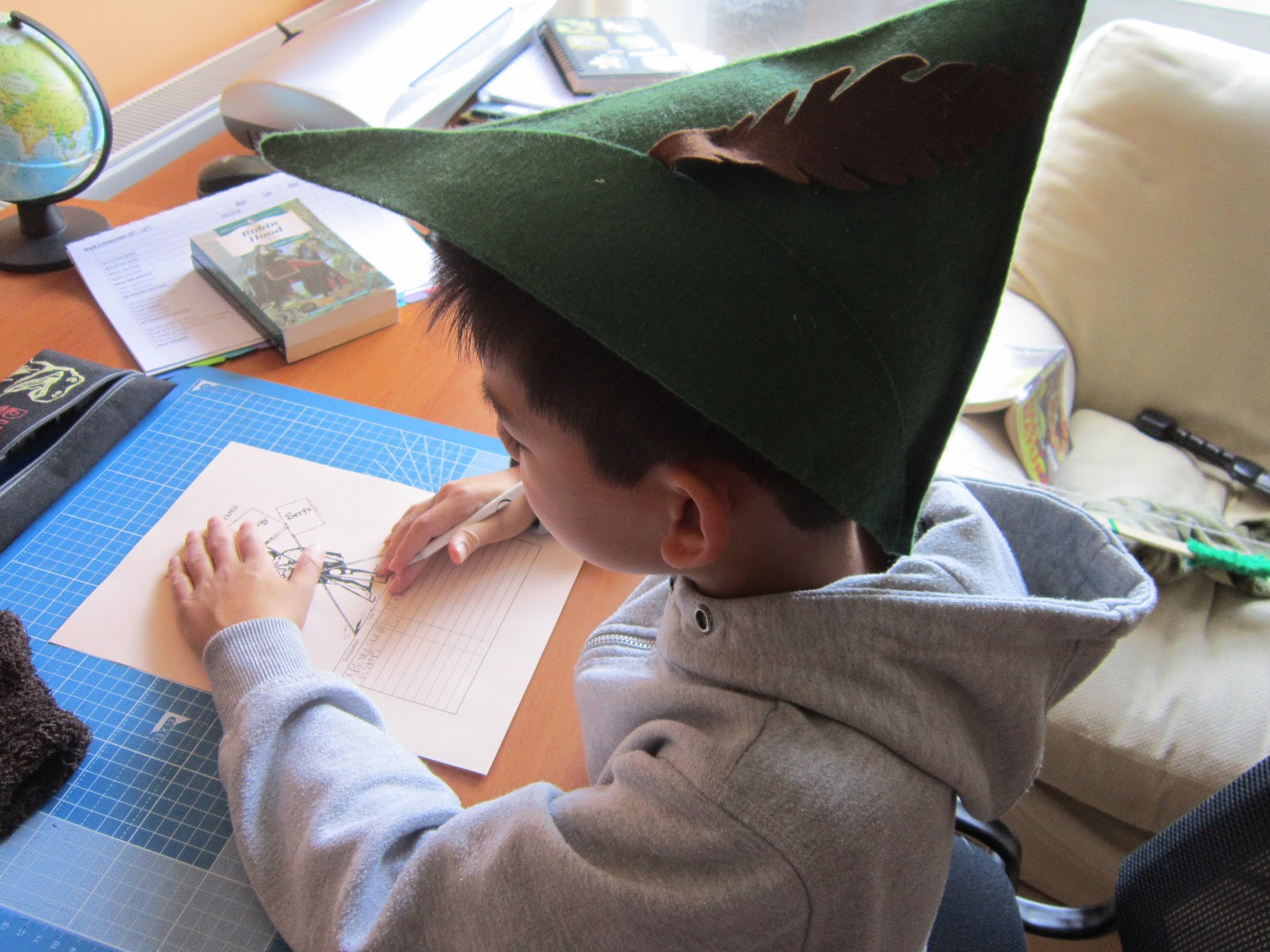
Tiger wore his Robin Hood hat to the event, and it became an impromptu topic for the man to talk about.  He told us how the hat would have been very useful when worn by hunters in different ways under different weather conditions.


This post is linked up to:
1) Enchanted Thursdays Blog Hop #39
2) History and Geography Meme #52
3) Homeschool Mother's Journal: November 30, 2012
4) Collage Friday
5) Favourite Resources: November 30, 2012
6) It's a Wrap
7) TGIF Linky Party #56
8) Weekly Wrap-Up

Friday, 17 February 2012

Trying the unit study approach


We are currently working through Marguerite Makes a Book.  This book has been chosen because:
1) the story was set in the Middle Ages;
2) we wanted to learn more about illuminated manuscripts;
3) the lesson plans are available free from here.

While the unit study approach appeals to me for its wide coverage of topics based on a single source book, I was not sure whether the lapbook aspect would appeal.  We made a few lapbooks in Tiger's preschool years and I thought they were too much trouble to make since I was the one doing most of the cutting and pasting back then.  This time round, I approached the lapbooking slowly so as not to overwhelm Tiger with the amount of work involved.  Surprisingly, this time Tiger took to it like a fish to water!  I think the success with lapbooking this time is due to the following factors:

1) Tiger being more developed in terms of fine motor skills so cutting and pasting do not tire him as much as they did when he was little;
2) Instead of putting the lapbook together in one go, as I did before, we put each part together as we worked through the unit.  This way, the project became manageable components rather than an overwhelming whole.
3) Tiger has been more involved this time in terms of designing and organising the lapbook.  After I explained what the lapbook templates were for, he had full control over the project.

So far so good.

Working slowly through the unit, we have touched upon geography when we had to find out the meaning behind the flag of France.


An interesting discussion came up when we examined the feudal system as part of understanding how society was structured in the Middle Ages.  Using the diagram, Tiger finally had a visual understanding of where knights were placed in the social hierarchy.  That led to us examining how and whether social structure has changed as much as we would like to believe.  It was slightly grim when we realised that we were just a little better than the peasant class.

Peasant or not, we moved along to appreciate great art in the form of a child-friendly version of the Book of Hours.  The stunning illustrations were done by the Limbourgh Brothers, whom we had studied previously.  The book gave a detailed description of each illustration, which helped us appreciate the artist's skills and use of symbolism.  We also looked at each picture to find details that we had missed when we studied the artist in Year 1.


After reading through the book, I took out the copies of art postcards that we used in Year 1 for artist study.  The cards were used to match against the pages from the book.


We both watched an excellent interactive demo of how a medieval manuscript is made.  The demo helped to cement what we know so far about the manuscript process.

Another superb example of medieval manuscript is the Book of Kells which is currently held in Dublin:


Compared to filling out workbooks, this approach takes a long time.  We seem to get side tracked at every point as we follow our interest before returning to the lesson plan.  So far we are still working through Chapter 1 but the process of learning has been immensely enjoyable, especially when we are being led into fascinating areas which would otherwise have been missed.  If we were just using this approach for Language Arts, I would be worried about whether Tiger is covering enough grounds for his basic skills such as grammar, writing and spelling.  Since those areas are being covered at other times in our week, we can indulge ourselves by taking an interesting route to reading and literature.

This post is linked up to several blog hops, where you can visit to see what other homeschoolers have been busy with.  It is also linked to the Homeschool Showcase #93.

Related Posts Plugin for WordPress, Blogger...