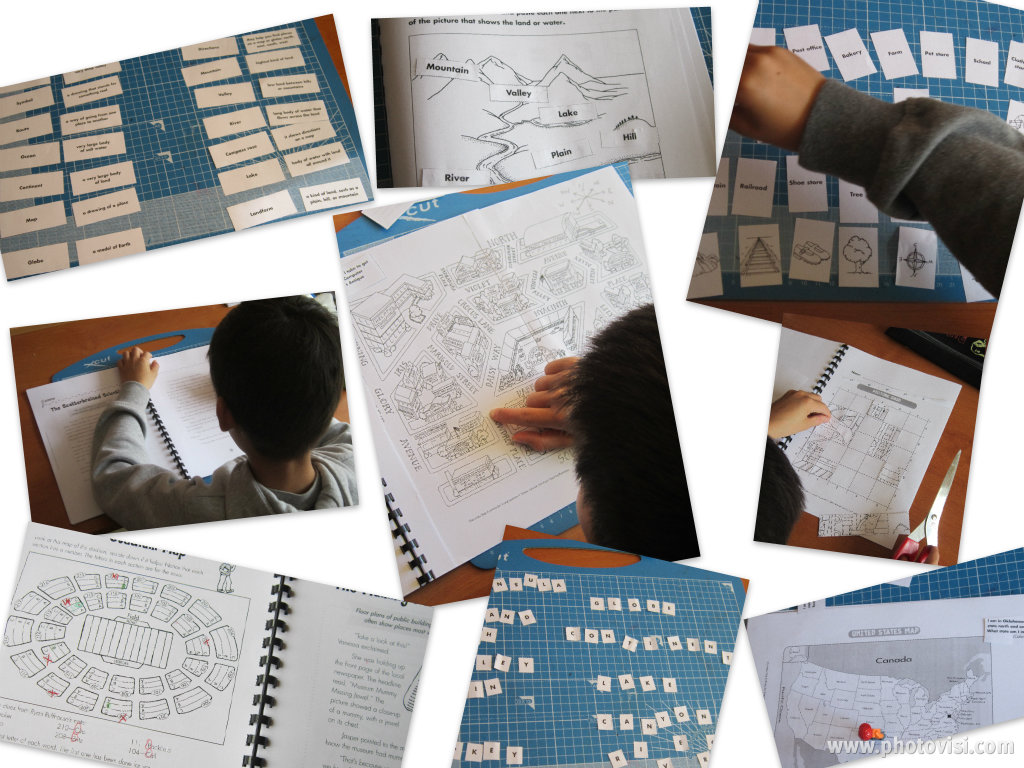
Thursday, 21 March 2013

What is the real distance?

With the launch of our Marco Polo study, we are beginning to increase our focus on Geography-related activities.  One of the things Tiger learnt recently was to use a map scale.

I introduced the lesson by having him make a world map using cut-outs of the seven continents, labels for four oceans, and labels for the equator and the prime meridian.


Once he was happy with the relative positions of the labels and cut-outs, Tiger checked his layout with that printed in a children's atlas before gluing his pieces in place.


Here was his initial piece.  Did you spot the mistake?  I didn't either.


It was Tiger who, after a few minutes, remembered our trip to the Royal Observatory in Greenwich where he had stood on the prime meridian.


What does that mean?  That means that in his previous layout, Europe was placed too far away from the line that represented the prime meridan.  I was very glad that Tiger made the connection himself and spotted his own mistake before I did.

So, he removed the pieces carefully and re-did the right-hand side of his map:

The correct map
We then used the map above to discuss the practicalities of using a scale to represent the actual distance and size of locations on a map.


In order to understand the concept of map scale better, I asked Tiger to copy the scale found in a map onto an index card, then use that copied scale to measure the distance of a few places on the map, for example between Manchester and London.


We tried out a few different examples to make sure that Tiger has understood completely how to use and read a map scale.  All of the examples so far measured direct, straight-line distances.  Following that, I asked Tiger how he would measure the distance of a winding road or river on a map using the scale.  Tiger suggested twisting and turning his index card scale this way and that, but I suggested to him that perhaps there was an easier way.  When he failed to think of it after a few moments, I suggested using a piece of string.


We ended the lesson with a quick review.


Inspired by the book, Tiger drew a few maps of different scales -- from the location of our county to a floor plan of the house.

Country map
County map
Town map
Street map
Floor plan

It's great when the child extends the lessons himself!

Our application work came about by (1) Tiger taking measurements of his own feet before working out the actual measurements of the room first in feet, then converting the feet measurement into centimetres and metres.


(2) Scaling up a copy of a small drawing.  This is a very common scaling up method used by artists.


Once the scaled up drawing was completed, Tiger went over the outline with a black permanent marker before filling in watercolour.


The lessons above come from these books:


This post is linked up to:
1) Look What We Did!
2) Hearts for Home Blog Hop #9
3) History and Geography Meme #67
4) Virtual Refrigerator
5) Homeschool Mother's Journal: March 22, 2013
6) Hobbies and Handicrafts - March 22
7) Collage Friday - Poetry, Pastels and Purging
8) TGIF Linky Party #68
9) Homeschool Review
10) Weekly Wrap-Up: The One with All the Birds
11) Math Monday Blog Hop #92
12) Hip Homeschool Hop - 3/26/13

Tuesday, 19 March 2013

Our Daily Schedule or Lack Thereof


One of the most frequent questions I get asked, when someone knows that we are homeschoolers, is whether I have some kind of timetable for our day.  I don't get such questions from other homeschoolers who have been doing this for a while so those who ask this question are usually parents who are either not homeschooling yet but are interested to know how to get started with lessons, or who are new to homeschooling.

I am guessing that the question arises as an extension of what most of us understand of how school works, that there is a set of allocated time for a certain activity before moving the herd to the next.  For those who are looking for the short answer to this question, my answer is: yes, I have a beautiful colour coded Excel spreadsheet pinned on the wall in front of our work table.


However, as I have written in another recent post about our day, the timetable is really a 'legacy system' that is leftover from our more structured days at the earlier part of our journey, especially in Tiger's kindergarten year when we adopted the Charlotte Mason approach of having short, 15-minute lessons.  We have since moved on from such a strict routine.

We are not totally without structure in our days though.  We have let go of structured timetable and curriculum schedules, but we have established a sense of "rhythm" for our days.  What I mean is that, from Monday to Friday, Tiger and I both understand that we will be productive from after breakfast to the time I start cooking dinner.  That's typically between 9:00a.m. to 5:00pm.  During this time, we can be engaged in a variety of different activities, for example:
  • academic learning at the table
  • watching documentaries
  • reading
  • researching
  • writing
  • artsy pursuits
  • going out on field trips
  • hands-on projects
  • having discussions
  • playing games (board games, chess, card games)
  • being in nature
  • external classes
There is a short break in the morning and a lunch break around mid-day.

The reasons I have let go of the formal structure (timetable, curriculum, and predetermined learning outcome) are:
1.  Tiger's ability to concentrate and follow up on a topic has increased as he gets older (compared to two years ago), so the short, timed lessons are not relevant anymore.

2.  When we are engrossed in a topic, we want to pursue it to our satisfaction so we often find ourselves spending an entire morning on Maths or sometimes an entire day on Military History.  On the other hand,  when the topic or learning resource does not inspire us (I still get it wrong sometimes) or when either one of us has had enough of it for the day, we can wrap it up in 10 to 15 minutes.  Tiger has been known to complete certain tasks in 5 minutes and I don't feel it is necessary to make him jump through more hoops on such occasions.

3.  Our learning isn't really limited to 9am-5pm either, which allows for flexibility in terms of 'down time' through sickness or simple non-productive moments.  At moments like these, I find it to be more effective to let Tiger rest, then pick up the study again after such moments have passed.  Therefore, we occasionally (not often) continue after dinner.

4.  When Tiger demonstrated his intention and ability to direct his own learning, I learned to reliquish the tight control I had over his time and curriculum.  I expect it will take a few years, but we have started the process of my gradually handing over the ownership and responsibility of learning to Tiger.  Our process is very dynamic.  The amount of ownership Tiger gets and the pace at which the handover takes place depend on his demonstrated level of maturity, discipline, and ability (both emtionally and intellectually).

5.  Some of Tiger's most interesting discoveries happened during unstructured time.  There is much value in self-discovery which cannot happen when the bulk of a child's day is overloaded with activities prescribed by someone else such that he is not left with any time or energy to be with his own thoughts or to find out who he is.

6.  As far as I know, all the great teachers throughout history -- from Confucius in the East to Socrates in the West -- did not use structured timetables or specific curricula with their students.  These great teachers taught a way of thinking, of learning, of being, of discovering which, unfortunately, do not come in a neat package off the shelf.  With this realisation, all forms of rigidity in terms of timetables and standardised curricula lost their appeal to me.  Having said that, if anyone knows which packaged curriculum or National Curriculum Socrates or Confucius had used, please let me know.  I'll be very interested to get my hands on them. 


Weekends are strictly family time.  That means no formal, sit-at-the-table type of learning, although much informal learning takes place without us consciously thinking about it.  As a family, we spend a lot of time conversing with one another.  The conversations and discussions that we have together often spark new ideas to be followed up in the following weeks.  The other function of our family conversation is that it is sometimes used as an informal assessment of what and how much Tiger has learnt during the week.

Those who are looking for a more structured approach, my post from two years ago of what our day looked like back then will give you a better idea of how to get started.

It is also beneficial to look at other homeschooling families' approaches to give yourself a few more ideas to apply to your family's unique situation:
  • Our Daily Schedule from Savannah @ HammockTracks, in which she talks about her life, from chore lists and meal planning to school work and extra curricular activities.
  • Homeschool Daily Schedules from Chareen @ Every Bed of Roses, in which she shares her love-hate relationship with schedules and how, over the years, she has had to learn to find a delicate balance between tight schedules and flexibility.

Next Tuesday, we will share our book recommendations for new homeschoolers.  I hope you will join us again then.

Friday, 15 March 2013

Homeschool Help: a new series


I started to blog about our homeschooling journey as a way to share our approach, as well as to connect with other families who are either already homeschooling their children or are considering the possibility of doing so.

Since the beginning of this journey, I have learned much from the many homeschooling bloggers who have generously shared their knowledge, ideas, and insights on their respective blogs.  As we are well into the eighth year of our own journey, I am coming across more parents, both online and in person, who are curious and interested to know more about homeschooling in general as well as more specific topics such as our schedule/routine, our curriculum, and how I balance my life.  Therefore, I gladly accepted an invitation to write a series on the basics of home education, together with four other homeschooling mothers.

This series is appropriately named Homeschool Help.  It is the brainchild of Savannah from Hammock Tracks.  The other contributors are:
  1. Julie from Highhill Homeschool
  2. Bernadette from Barefoot Hippie Girl
  3. Chareen from Every Bed of Roses
  4. myself
I'm excited about participating in this project for the potential mix of different perspectives and ideas on each shared topic, resulting from having a team from different backgrounds and who are living in different geographic regions (two in the USA, one in Australia, one in Germany, and one in England).  The potentially varied responses by each contributor will hopefully mirror the wide spectrum of possible ways to approach homeschooling.  Writing for the series also gives me a reason to talk about things that have become second nature to me after so long that I don't even think about them anymore, but I recognise that such things (e.g. juggling housework and homeschooling) may still be relevant and of interest to new homeschoolers.

How does the series work?
The series starts next week.  Each contributor will publish her individual response to the weekly topic on Tuesday at 1100hr GMT, with a link to the corresponding entries in the other four participating blogs.

What are the topics?
The specific topics may subject to some changes later on, but in the pipeline at the moment are the following:

March

April

May

June
Your Favourite Apps (iPad or Droid) or Learning Websites

August
  • What's New in Your Curriculum?
  • What's New in Your School Room?
  • What is Your Teaching Style for the New Year?
  • Poetry - How do you teach it?

September
  • Reading - What are you and your kids reading?
  • Journaling - How do you do it?  Art Journal?  Math Journal?
  • History - How do you do it?
  • Help!  My Child Hates Math!

October
  • Help!  My Child Hates Writing!
  • Dad: His Role in Homeschooling
  • Foreign Language
  • Your Top 3 Suggestions for Someone who Pulled Her Child Out of School Mid Year

November
  • Year Round, or Not Year Round?
  • Grades: Do you Give Them?  Why or Why Not?
  • Overload - What to do when You Run Out of Fuel
  • Your Top 6 Favourite Read-Alouds (Picture Books)

December
  • Your Top 6 Favourite Read-Alouds (Chapter Books)
  • The Year in Review: What You Want to Remember

I look forward to sharing my ideas with you on the various topics.  See you next Tuesday!


This series is featured on Homeschool Chicks.


Thursday, 14 March 2013

The start of a new adventure


For the most part of this term and beyond, our learning will mostly be based on The Travels of Marco Polo.


When I did the planning for this topic, I found that this can be turned into a cross-curricula, theme-based learning -- much like a unit study -- since it covers so many different areas: history, geography, science, maths, art, craft, music, food, and literature.  Hence, I shall be posting about our learning adventures and resources as we follow Marco Polo's journey to the East and back.

As this unit is going to be heavy on geography, I had Tiger work through the Marvelous Map Activities for Young Learners and Fun-to-Solve Map Mysteries to gauge his understanding of basic physical geography knowledge.


Until now geography was not our focus, even though we have been incorporating map work consistently as part of our history lessons, so I feel it is important for me to have an idea of how much Tiger already knows (or not) to plan our lessons effectively.  He flew through the first two books, but needed some help with Great Map Mysteries, which covers topics such as grid map, map scale, and time zones.

With the basics out of the way, we started getting an overview of Marco Polo and his travels by reading generically about him:


We also found the following documentary very useful to prepare us to join Marco Polo on his adventures:


There seems to be various maps around that show slightly different locations of Marco Polo's journey.  We have tried to cross-reference the various maps to arrive at our own conclusion as to the present-day equivalent of where he would have been.


So far, we've figured that his outbound journey was as follows:
Venice (Italy) --> Jerusalem --> Lebanon --> Constantinople (Turkey) --> Armenia --> Baghdad (Iraq) --> Persia (Iran) --> Herat (Afghanistan) --> Kashgar (Central Asia) --> Tibet --> Mongolia --> Khanbaliq (Beijing in China)

When Marco Polo was at the service of Kublai Khan, he made the following journey:
Khanbaliq (China) --> Myanmar (Burma) --> Java (Indonesia) --> Eli (India) --> Khanbaliq (China)

His homeward journey was:
Zaitan (Xiamen in China) --> Vietnam --> Malaysia --> Singapore -->  Sumatra (Indonesia) --> Ceylon (Sri Lanka) --> India --> Persia (Iran) --> Caucasus (Azerbaijan, Georgia) --> Constantinople (Turkey) --> Venice

Therefore, we will be studying the cultural and physical geography of the following countries/cities as we travel along with Marco Polo:
  1. Italy
  2. Jerusalem
  3. Lebanon
  4. Turkey
  5. Armenia
  6. Iraq
  7. Iran
  8. Afghanistan
  9. Kashgar
  10. Tibet
  11. Mongolia
  12. China
  13. Burma
  14. Vietnam
  15. Malaysia
  16. Singapore
  17. Indonesia
  18. Sri Lanka
  19. India

This post is linked up to:
1) Creative Kids Cultural Blog Hop #1
2) Great Book Lists and Literacy Projects for Kids
3) Hearts for Home Blog Hop #8
4) History and Geography Meme #66
5) Homeschool Mother's Journal: March 15, 2013
6) Hobbies and Handicrafts - March 15
7) Collage Friday - Making Hard Life Choices
8) TGIF Linky Party #67
9) Homeschool Review - March 15
10) Creative Learning Link Up #6
11) Weekly Wrap-Up: The One Where I Got to Go On a Retreat
12) Share it Saturday - St. Patrick's Day Features
13) The Sunday Showcase - 3/16/13
14) Hip Homeschool Hop - 3/19/13
15) Look What We Did!


Thursday, 7 March 2013

What's the time, Mr. Wolf?

To start off this topic, Tiger read a book that we have on the shelf for many years and that which was used a few years ago in his preschool years:


As a revision to what Tiger already knew of reading the clock, we worked through the Telling Time activity by making a clock face and reading various times.


To make sure that Tiger knew how to tell time both in numbers and words, we played the What's the Time? game.  First we matched the words with the time shown on the clock faces, then we turned the pieces of paper over and played a memory game with the same set.


After the basic telling time exercise, we proceeded to work out a few problems that required carrying over between hours and minutes.


We then worked through a few maths games:
1. Clocks
2. How Many Times?


3. The Time Is... For this game, Tiger started out sequencing set A, followed by set B.  He then combined both sets and sequenced all the cards.  The interesting part of this game is the mixture of analog and digital times, so that the analog clock is open to interpretation as to whether it shows A.M. or P.M.  I told Tiger that as long as he could provide a valid reason to the way he sequenced the cards, it's entirely up to him how he interpreted the analog time.


4. Two Clocks

5. The trickest of all was the Wonky Watches, which required quite a bit more thinking, as well as applied division.


To take another perspective on the concept of time, Tiger read this book,


followed by a related clip:


All of a sudden, our maths topic took on a turn into physics, so we watched two more clips which led to more discussions about the concept of time, how it came about, using maths to represent observations and natural phoenomena, the correlation between the initial hypothesis and the mathematical proof, etc.


Did we understand everything from the two clips above?  No.  Did watching them generate some interesting questions and discussions between us?  Yes, and that's good enough for us for now.

This post is linked up to:
1) Hearts for Home Blog Hop #7
2) Hobbies and Handicrafts - March 8
3) Collage Friday - I wouldn't Trade This for the World
4) TGIF Linky Party #66
5) It's a Wrap
6) Creative Learning Link Up #5
7) Weekly Wrap-Up: The One where Most of the Kids were Sick
8) Share it Saturday - Exploring Color
9) The Sunday Showcase - 3/9/13
10) Math Monday Blog Hop #90
11) Hip Homeschool Hop - 3/12/13
12) Look What We Did!  

Friday, 1 March 2013

Translation, Reflection, and Rotation

As a follow up to learning about symmetry, we looked at a very similar and much related concept of translation, reflection, and rotation.  Afterall, there are three basic types of symmetry: horizontal, vertical, and rotational.

The concept is easily shown by taking a half-photo of anything.  In our case, I have Tiger trace out three copies of the half-photo of a lion.


Then place the traced images next to the original half-photos to show the three concepts.  We also did a short quiz to make sure Tiger has understood the concept.


We played a simple game of writing in different ways using a mirror, testing out the concepts we just learnt.


The final application of the concept was more complicated, as Tiger was tasked to apply all that he has learnt to copy the original design from one quadrant to three other quadrants.  That took a bit more time.


The ideas for the lessons come from the following books:


After the book lessons, Tiger hopped onto the computer and tried his hands at the following games:
  1. Putting Two and Two Together
  2. Nine-pin Triangles
  3. Transformation Tease 


This post is linked up to:
1) Hearts for Home Blog Hop #6
2) Homeschool Mother's Journal: March 1, 2013
3) Hobbies and Handicrafts - March 1
4) Collage Friday - Sharks, Titanic, and Handel
5) TGIF Linky Party #65
6) It's a Wrap
7) Creative Learning Link Up #4
8) Weekly Wrap-Up: The Strangely Bittersweet One
9) Share it Saturday - Dr. Seuss Features
10) The Sunday Showcase - 3/2/13
11) Math Monday Blog Hop #89
12) Hip Homeschool Hop - 3/5/13
13) Look What We Did!

It is featured on Look What We Did! 10 Great Resources: Math, Science, History, and Art.


Related Posts Plugin for WordPress, Blogger...