This week's science lesson required that Tiger observe a few small, live animals to compare and contrast their characteristics. Armed with the record sheet, we headed to the pet store in town.
Since we are still studying vertebrate, we concentrated our observations on this group of animals. The pet store is quite sizeable, so we were able to spend an hour there for our "lab" to look closely at three out of the five vertebrate groups: reptiles, mammals, and fish.
Bearded dragons
Rabbits
Guinea pigs
Fish
Prior to this lesson, I had taken for granted the observational skills required to look closely at things and to translate what we see into descriptive words. This lesson gave us a good reminder of this very important scientific skill.
During the lesson, Tiger was challenged to take his observations further by thinking of the following questions:
Both rabbits and guinea pigs are furry, but is there any difference in their fur?
Fish don't have legs so how do they move along in the water? Would legs be useful for an animal that lives in water all the time?
All the animals we saw, apart from fish, have four legs. How are the positions of their legs different, and why are they positioned as such? How does that affect the animal's movement? Why is it necessary for that animal to move in that way?
Where are the animal's eyes positioned? Why are they positioned as such? Does the position affect their roles as either prey or predator?
I finally attended the one-day creativity workshop that was initially to have taken place in November, but which I had to postpone attending due to Tiger's viral infection. I signed up for this workshop with the aim to be more informed of the different ways to teach art and drawing, to widen my perception of creativity, and to learn from other art teachers. The workshop met all of my objectives and more -- it has left me feeling stimulated and more confident about letting Tiger (and myself) explore seemingly unrelated avenues of artistic expression without worrying too much that Tiger is not yet ready to learn representational drawings.
The workshop room at lunch time.
The workshop leader was a very experienced teacher-trainer and practising artist. What a fantastic combination! He not only gave us many thought-provoking exercises that helped us to get out of our comfort zones, for example (1) focusing on a single part of the life model and finding ways to represent the texture and (2) gradually reducing the number of strokes to represent one posture, but also validated an acceptance to the different styles of artistic expressions.
The following pieces of "family-friendly" work I did on that day give a good glimpse of my experience.
Close-up of the model's hand and foot.
An interpretation of a fellow participant's palm.
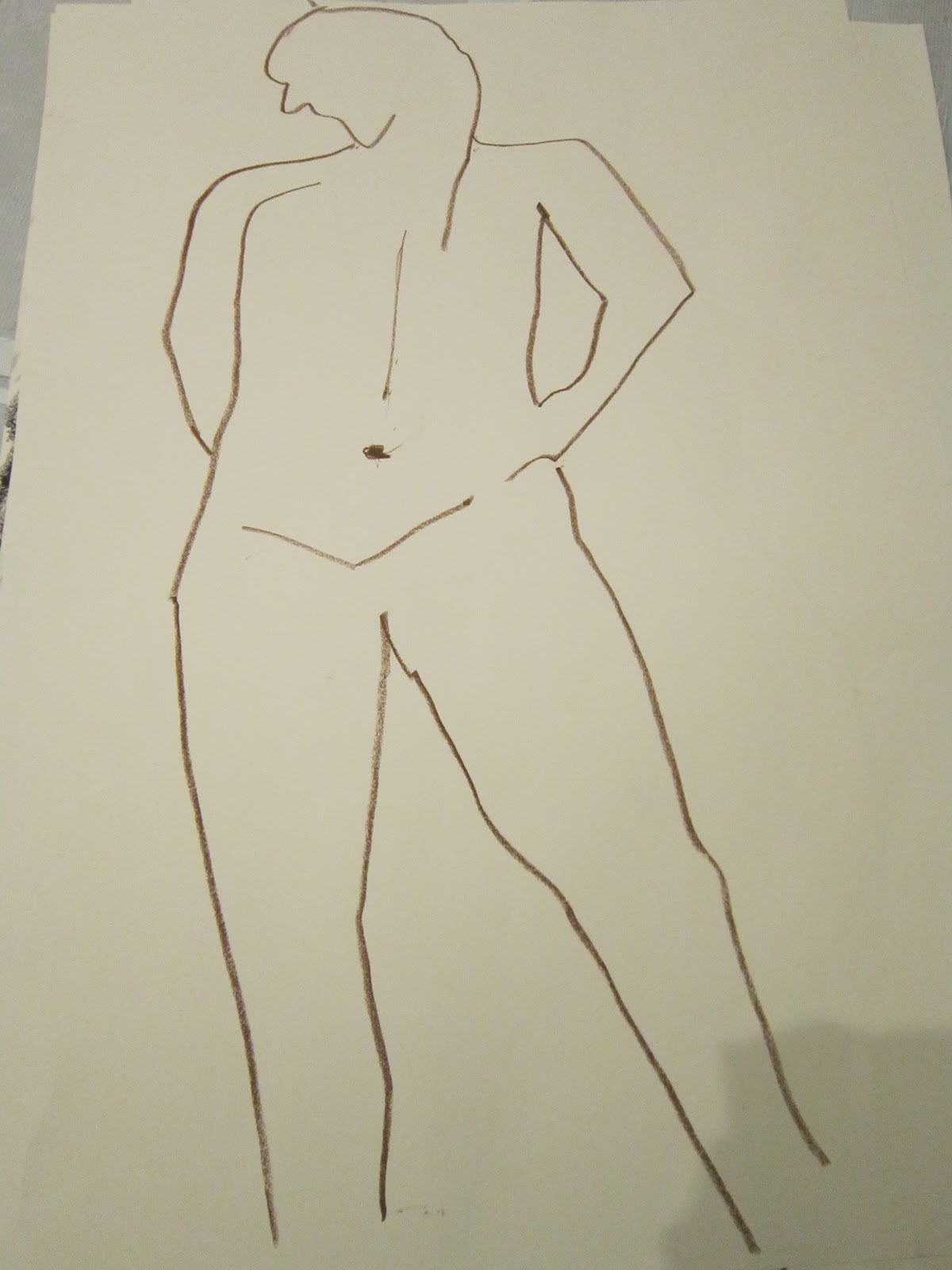
The life model.
Drawing with 10 lines.
The same pose in 3 lines.
The biggest learning points for me from the workshop are:
1) individual responses and interpretations of the same subject are different and valid, as long as the finished work is what the artist want to convey;
2) it is perhaps more important for the artist to connect with his/her subject and convey that connection down on paper (which is then conveyed to the audience viewing the final work), rather than being technically perfect but disconnected;
3) connectivity needs to be borned out of freedom of expression;
4) technical perfection is helpful but can hinder the artist's expression if he/she becomes too rigid about technicalities;
5) different forms of artistic exercises and ideas can increase the development in another art form -- creativity can 'cross-pollinate'.
Before attending the workshop, I wondered whether I ought to introduce formal drawing lessons to Tiger so that he can "draw better". Having attended the workshop, I no longer worry about this. We do a lot of visual art at home, and I am now reassured that each activity forms a different experience for Tiger which has a cumulative effect on how he chooses to express himself. We can afford to wait a few more years for Tiger's fine motor skills and ability to concentrate for longer periods of time to develop, so that he may then learn formal drawing skills in the most effective way.
I could not stop laughing when I read about the interaction between a mother and her offspring here. Seriously, I am not always like this, even though Tiger would have you think otherwise. Most of the time I actually look like this:
Following our study of Medieval Japan in history, we delved a little more into the cultural aspects of the country by studying the art of a Japanese master, Hokusai.
Art appreciation - preparation
As usual, I displayed a few of the artist's representative works up on our cupboard for Tiger to familiarise himself with them.
Since we did not know much about Hokusai and his work, we decided to learn more about him by reading the following books:
As with many great artists, Hokusai was a versatile artist in that he was very skilful in many different forms of art, the most significant ones being ukiyo-e and woodblock prints. I could not decide which style to focus on for our study, so in the process of searching, we first looked closely at one of his works using the following book:
Art appreciation - focused study
As we learned more about Hokusai's woodblock prints, we came across the The Great Wave documentary, and decided that we would focus on this particular masterpiece:
Once we have decided upon one single piece of work to focus on, we learned more about it through reading:
and completed the observational exercises from the lesson plan here, including mirroring our hand posture to that of the wave:
Field trip
Our timing to study The Great Wave could not have been better since we were able to attend a special exhibition on this work at the British Museum where we not only saw heard an expert lecture on the significance of and story behind this piece of work and saw one of the original prints on display,
we also learnt much about Hokusai's other woodblock prints, as well as the woodblock printing process.
Hands-on Project
We decided that Tiger would have a go at making his own prints following Hokusai's style. Our project instructions are taken from this book:
First, Tiger had to decide on the pattern that he wanted to print. After some discussion, he decided that he wanted to print a dragon in the oriental style. We looked on the internet and found a simplified version of what he wanted:
Next came the transfer of the image onto the styrofoam pizza base. Since Tiger was not confident about drawing freehand yet, he adopted my suggestion of transfering using the tracing paper.
Once the initial pattern transfer had been done, it was time to 'carve' out the indentation of the dragon. We used the end of a teaspoon to press on the outline of the pattern.
The printing began after this. Tiger chose different coloured papers for his base, then applied paint onto template with a roller.
After printing a few monotone copies, Tiger decided to change his output slightly by applying multiple colours to the template all at once. While Tiger understood that the actual woodblock print process would have used one colour at a time, he did not want to repeat the process multiple times. Therefore, Tiger's multi-coloured prints were each done at one go.
Extension
After the prints were completed, Tiger wrote an advertisement, complete with a web address and telephone number, to sell his prints for £4 each. When asked to explain how he came up with the £4 price tag, Tiger explained his rationale: he did a quick mental estimate of the amount of effort involved to produce the prints plus the amount of paint used.
So far, everyone who reads this blog has read about our homeschooling journey from my point of view. Here is a glimpse of the other (Tiger's) side of the story.
When asked to describe our typical homeschooling day, Tiger drew the following pictures. The first one is obvious:
"Do your lessons!"
The second one represents him:
"The monkey is very happy."
Ah, the joys of self-expression! Personally, I think Tiger has caught the essence of his mother rather well, albeit not quite the 'Zen Mum and the angelic child' picture that I had hoped to see. That aside, I am very glad Tiger feels no inhibitions when it comes to telling me what he really thinks.
After a short study of the Korean history and culture, we spent a much longer time on Japan. Last year's study of ancient world history has taught us that mythologies and legends can give us much insight into the cultural aspects of a civilisation, so that was where we started with our Japan study -- by reading stories from Japanese legends and myths:
It was fascinating for us to learn that the Yamato family has been ruling Japan for over 800 years. To understand more about this unique situation and to know more about this family, we watched the following clip:
We then headed to the British Museum's Japan gallery to see artefacts for ourselves, while we learned more from joining a gallery tour.
Tiger, being fascinated for the longest time about warfare and warriors, stood for a long time in front of the samurai cabinet to admire the samurai swords and armour:
Naturally, this was followed by reading up on the samurai and comparing how they were different from the English knights (in terms of armour, training and culture) that Tiger is so familiar with:
The samurai seemed to have thrived in the Edo Period, which occurred a few hundred years after the Yamato family first took control of the country. The following documentary helped us gain a better understanding of the samurai and the period they lived in:
When asked to choose a hands-on project for this topic, Tiger chose to make a samurai helmet. Is anyone surprised at his choice? I'm not. We followed the instructions from this book:
Making the samurai helmet was no small feat. It took Tiger a few days to complete it, and involved plenty of measuring, drawing, cutting, pasting, painting, folding, and assembling, as documented below:
Tiger's effort paid off in the end, as he now has a samurai helmet to add to his "armoury":