Showing posts with label lit-Marco Polo. Show all posts

Friday, 28 June 2013

The Italian Experience: Ready to Depart

I haven't expected us to be spending so much time just learning about Italy.  It has been four months since we first started with Marco Polo and we haven't even left Italy yet!


Luckily our current approach to home education gives us the flexibility to study a topic in depth without having to rush through it.  However, I think we have had enough of Italy by now so I am happy to report that we are finally wrapping up at a suitable place - by the coast.

We were at Canterbury over the weekend where we walked along the Roman city wall.


We were on our way to see the Reculver Towers and Roman Fort.  It location is stunning and right by the coast.  Very appropriate for a departure by sea (as Marco Polo did when he first left Venice), don't you think?


Before we departed, we had a very delicious meal at an Italian restaurant.  The food was so good that I completely forgot to take photos of them until we had finished eating... Fortunately, the restaurant has a shop section that sells food-related items from Italy so I took a few shots of the wide variety of food stuff there:


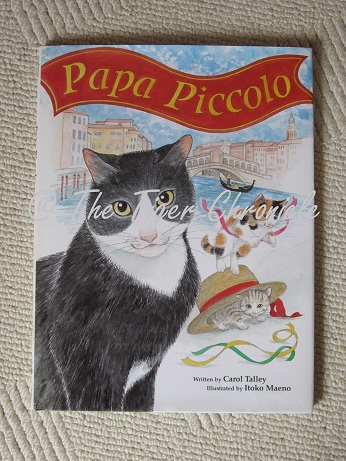
Since we have been all over the place (in time), reading the historical fiction recommended by Julie from Highhill Education has been very useful to take us back to 13th century Venice.


We are going to take a break from The Travels of Marco Polo for now and resume his journey in the autumn.  You can read all of our Italian Experiences with him here.

This post is linked up to:
  1. June Culture Swapper
  2. History and Geography Meme #80
  3. Hobbies and Handicrafts - June 28
  4. Collage Friday - Being Intentional About Doing Nothing
  5. Weekly Wrap-Up: The One with Gymnastics Camp
  6. Hip Homeschool Hop - 7/2/13

Monday, 24 June 2013

The Italian Experience - Roman Baths


Learning about Mount Vesuvius' eruption has given us a reason to revisit some aspects of the Roman culture, which in turn is the perfect excuse to visit the city of Bath...


and its world famous Roman Baths.


The exterior of the site is very impressive.  There are classical statues all around it (built during the Victorian times) with the original bathing pool extremely well preserved.


Compared to my previous visit to the Roman Baths about 15 years ago, the venue has had a major makeover with a large exhibition room.  The exhibits are all very clearly labeled, with detailed explanations and models.  There was a section about Roman life in general, and the people who would have visited the baths back then.


We also learnt that the site was much bigger than what has been preserved, and that there was a temple attached to the bath.  It seems that the Romans made an occasion of visiting the baths not just to clean themselves but also to seek healing from a sacred spring as well as to visit the temple of Sulis Minerva.


What we found to be most interesting was the section about the structural design of the baths.


We also attended the guided tour to learn more about the structure and history behind the baths behind the archaeological findings.


Watching the following documentary adds on to what we have learnt about the structure of Roman baths:


We were very impressed by our visit.  It is definitely a place worth visiting.  You can take a virtual tour of the great bath (the largest pool) here.


This post is linked up to:
  1. June Culture Swapper 
  2. Hip Homeschool Hop - 6/25/13
  3. History and Geography Meme #80
  4. Hobbies and Handicrafts - June 28
  5. Collage Friday - Being Intentional About Doing Nothing
  6. Weekly Wrap-Up: The One with Gymnastics Camp

Thursday, 13 June 2013

The Italian Experience - The Disaster

For some reason, we did not study the infamous eruption of Mount Vesuvius when we studied Ancient Rome.  Luckily, we get to do it this time round because of Marco Polo.  Who would have guessed?

We started by reading many books about the event in Pompeii:


This was followed by several cross-curricula activities from this book, which included learning about Pliny the Elder's route (geography), reading a play version of the story of Pliny the Elder as narrated by his nephew (comprehension, drama, reading), and labeling parts of a volcano (earth science).  The more hands-on activity was the making of a topologic map, 3D model of Mount Vesuvius.


Tiger used some terracota-coloured clay and worked layer-by-layer using the copy of the topologic map provided in the book.  The final result:


Originally, I only intended to watch one documentary, but we ended up watching three different ones to get a really good understanding of the event from different perspectives:


With a good understanding of the event, we were able to better appreciate our visit to the Life and Death: Pompeii and Herculaneum exhibition that is currently showing at the British Museum.


While we were there, Tiger attended a full-day workshop related to the exhibition.  At the workshop, the children were introduced to several re-enactors who took on different roles as people who were in Pompeii on that fateful day in AD79: Pliny the Elder, Pliny the Younger, a freed slave girl, a rich merchant, a priestess, a slave.  Through their interaction with these different characters inside the exhibition hall, the children were given good insights into life in Pompeii at that time, how people lived, their different roles, and how the Roman societal hierachy was organised.


We enjoyed our visit to the British Museum so much that we are going to relive the experience on the big screen next week!


This post is linked up to:
  1. June Culture Swapper 
  2. History and Geography Meme #78
  3. Hobbies and Handicrafts - June 14
  4. Collage Friday - Try Not to Destroy Their Imagination
  5. Weekly Wrap-Up: Camp Week
  6. Science Sunday: Happy Father's Day
  7. Hip Homeschool Hop - 6/18/13

Friday, 24 May 2013

The Italian Experience - Mosaics


When we look into the traditional art associated with Italy, the one that we come across the most is mosaics.  I wonder whether this is due to the influence of the Roman culture, which is also our main association to mosaics.

We started off our exploration of mosaics with a set of puzzles that Tiger had used when he was a preschooler.  Following last week's land and water forms exercise (also from his preschool days), we seem to be feeling rather nostalgic lately.  Maybe it's because the academic year is coming to a close soon and I am feeling more reflective about what we have done so far.


Once Tiger has the hang of forming a mosaic picture from the above exercise, I wanted us to make one out of paper.  To get our design inspiration from real mosaics, we went to look the V&A.  The V&A prides itself as a design museum, so everything in it is filled with ideas for designers.  We had a good look at the different patterns on its mosaic floors as well as a few more modern mosaic portraits on the wall.


 At home, we proceeded with our paper mosaic project.  We cut an A4-sized white card into two to use as our base.  Then we each sketched the outline of our designs using pencil before filling the designs in lightly with coloured pencils.  This is to help us plan where the colours go.

Tiger's design

My design

We gathered all the coloured craft papers we needed, measured and drew 1cm squares on each and cut them up with a pair of scissors.  The coloured paper tiles were put in plastic trays by colours for ease of use.  Then we glued each paper tile onto our designs carefully, one colour at a time.


The paper mosaics took a while to complete but it was a fun exercise.


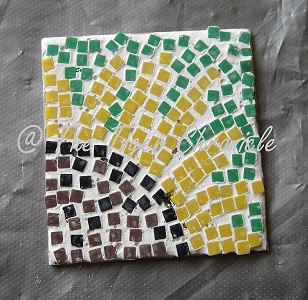
Finally, I gave Tiger a mosaic tile set that I bought from a craft shop.  The set came with ready-cut tiles, a wooden base, ready-drawn design, and grout.  All Tiger had to do was to assemble it.


Tiger actually prefers to make his own paper mosaic rather than to use the ready-made set because:
1) he prefers to draw his own design, and
2) the tiles in the set are all standard 1cm squares, and we cannot cut the tiles easily without making a mess and breaking them.  The inability to cut the tiles results in a less refined finish.


This post is linked up to:
  1. Look What We Did!
  2. Virtual Refrigerator
  3. May Culture Swapper
  4. Creative Kids Culture Blog Hop #4
  5. History and Geography Meme #75
  6. Hobbies and Handicrafts - May 24
  7. Homeschool Mother's Journal: May 24, 2013 
  8. Homeschool Review
  9. Collage Friday - Time for Nothing and an Exciting Something
  10. Weekly Wrap-Up: The One at NCHE
  11. Hip Homeschool Hop - 5/28/13

Wednesday, 15 May 2013

The Italian Experience - The Most Famous Love Story

Tiger has already read the story from Tales of Shakespeare and other abridged versions.  He also remembers the masks that he decorated, which he thinks will come in handy in the masquerade party in the play.  He also watched the BBC animated version of Romeo and Juliet.


After our previous successful trip to The Globe, Tiger asked to go there again.  On his own accord, he started to read the original play at home and took it along on the day of the performance to "match what the actors are saying with the script" (his words).  The version that he read is one that is used in schools -- with the dialogues on one side and the corresponding analysis on the other.  I wasn't expecting him to read the actual play until later, but if he wanted to do that and has enjoyed doing so (as he told me afterwards), then I won't hold him back unnecessarily.


The production at The Globe that we watched was one that was specifically put up for the benefit of students who are taking literature GCSE exams this year, as Romeo and Juliet is one of the selected texts for the exam. 


The performance, although the actors still spoke in the original Shakespearean language, was modernised in its props and costumes, which reminded me more of West Side Story than the usual Elizabethan stage than we were expecting to see at The Globe.  It is very unusual for The Globe to perform in a modern version so I wonder whether it was a deliberate action to get the secondary school children interested.

I was very impressed by the performance nonetheless, as I felt that I now understand the play and the emotions within the characters more after watching the performance.  However, Tiger didn't like the modernised parts of the performance.  He wanted to see the traditional Elizabethan version that The Globe did a few years ago:


Tiger was also not impressed with the audience that day.  Compared to the very civilised, interested, paying public whom we sat amongst to watch The Taming of the Shrew, this time we were amongst secondary school groupsWatching from the side where we were sitting, it was clear that some of the school children / teenagers really didn't want to be there.  Tiger was slightly baffled at one point by the disinterest he saw in the majority of the school-attending audience.

The quality of the audience and the modernisation of the play, both of which Tiger didn't take to, helped me make up my mind about not attending school matinees at The Globe anymore.  I would rather pay the full price to have the same experience as we did with The Taming of the Shrew.


This post is linked up to:
1) Look What We Did!
2) Hobbies and Handicrafts - May 17
3) Collage Friday - Math, Appliances, and Other Goodies
4) Weekly Wrap-Up: The One Where I Didn't Go to Nashville
5) Hip Homeschool Hop - 5/21/13

Thursday, 4 April 2013

Traveling with Marco Polo: Venice

History and Geography
We start our journey with Marco Polo at the beginning -- his hometown, 13th Century Venice.  The lesson plan on the website involves a fair bit of interactive, online resources that Tiger enjoyed working on, especially the map-maker, tracing Marco Polo's route, and making the brochure.  After that, Tiger jumped on Google Map to have a virtual tour of Venice.


We also watched the first six-and-a-half minutes of the following clip to get a better understanding of Venice during Marco Polo's time:


Music
Most days, we have the following music playing in the background from lunch time onwards.


Art and Craft
The Wallace Collection has two rooms dedicated to Venetian art where we had a good look at the paintings depicting Venetian life and street scenes of the 15th-18th centuries.


Venice was a busy trading centre when Marco Polo was growing up so he would have seen many of the activities by the port where he lived.  We also learned that jewellery beads that were made in Venice at that time was a popular trade item.


I have a friend who is an expert polymer clay jewellery maker so Tiger and I spent an afternoon learning the trade from her.  Tiger made a ring, several pendants, a few beads, and a pencil cover.


Food and Cooking
I suspect the 13th Century Venetians ate very different food from what we know as popular Italian food, but I am happy to serve up what I know to support our 'travel' in Venice: pasta dishes and pizza.


Tiger also made his own pizza, from reading the instructions on a recipe book, measuring the amount of ingredients he needed, to mixing, kneeding, and putting the toppings on:


Books
Just to have a broader sense of the country beyond Venice, Tiger read the following books:


This post is linked up to:
1) Look What We Did!
2) Culture Swapper - April
3) Virtual Refrigerator
4) History and Geography Meme #68
5) Homeschool Mother's Journal: April 5, 2013
6) Hobbies and Handicrafts - April 5
7) Collage Friday - Surprises on Spring Break
8) Homeschool Review
9) Weekly Wrap-Up: The Really Busy One Before Spring Break
10) Kids in the Kitchen - Clam Chowder
11) Hip Homeschool Hop - 4/9/13

Thursday, 14 March 2013

The start of a new adventure


For the most part of this term and beyond, our learning will mostly be based on The Travels of Marco Polo.


When I did the planning for this topic, I found that this can be turned into a cross-curricula, theme-based learning -- much like a unit study -- since it covers so many different areas: history, geography, science, maths, art, craft, music, food, and literature.  Hence, I shall be posting about our learning adventures and resources as we follow Marco Polo's journey to the East and back.

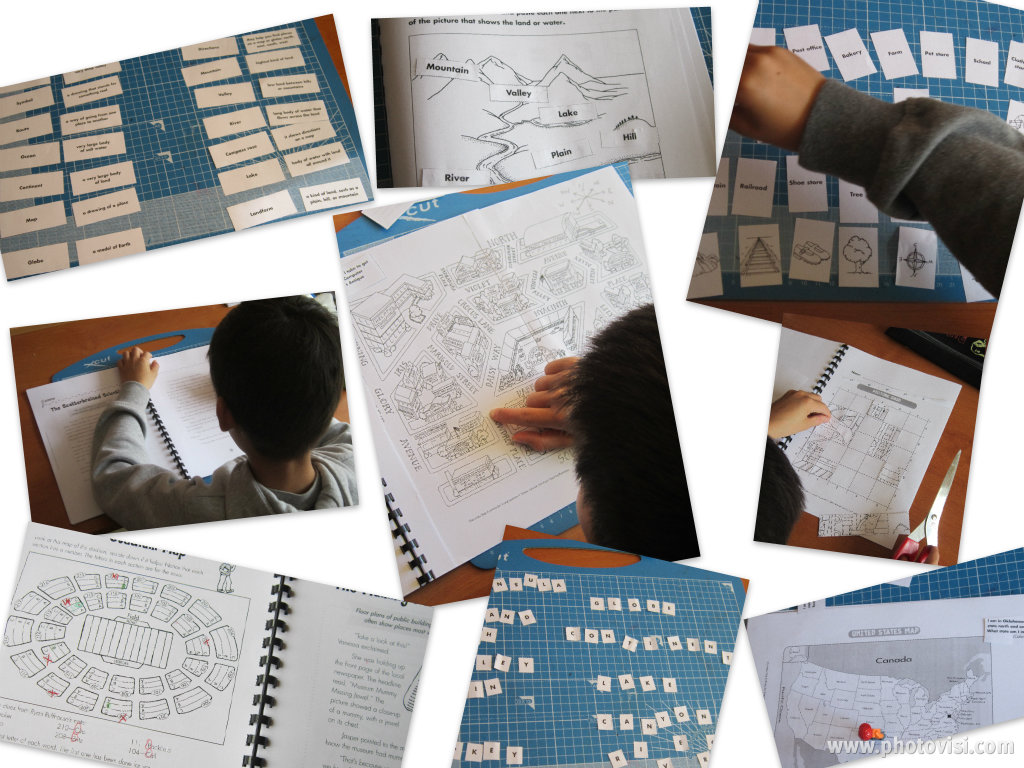
As this unit is going to be heavy on geography, I had Tiger work through the Marvelous Map Activities for Young Learners and Fun-to-Solve Map Mysteries to gauge his understanding of basic physical geography knowledge.


Until now geography was not our focus, even though we have been incorporating map work consistently as part of our history lessons, so I feel it is important for me to have an idea of how much Tiger already knows (or not) to plan our lessons effectively.  He flew through the first two books, but needed some help with Great Map Mysteries, which covers topics such as grid map, map scale, and time zones.

With the basics out of the way, we started getting an overview of Marco Polo and his travels by reading generically about him:


We also found the following documentary very useful to prepare us to join Marco Polo on his adventures:


There seems to be various maps around that show slightly different locations of Marco Polo's journey.  We have tried to cross-reference the various maps to arrive at our own conclusion as to the present-day equivalent of where he would have been.


So far, we've figured that his outbound journey was as follows:
Venice (Italy) --> Jerusalem --> Lebanon --> Constantinople (Turkey) --> Armenia --> Baghdad (Iraq) --> Persia (Iran) --> Herat (Afghanistan) --> Kashgar (Central Asia) --> Tibet --> Mongolia --> Khanbaliq (Beijing in China)

When Marco Polo was at the service of Kublai Khan, he made the following journey:
Khanbaliq (China) --> Myanmar (Burma) --> Java (Indonesia) --> Eli (India) --> Khanbaliq (China)

His homeward journey was:
Zaitan (Xiamen in China) --> Vietnam --> Malaysia --> Singapore -->  Sumatra (Indonesia) --> Ceylon (Sri Lanka) --> India --> Persia (Iran) --> Caucasus (Azerbaijan, Georgia) --> Constantinople (Turkey) --> Venice

Therefore, we will be studying the cultural and physical geography of the following countries/cities as we travel along with Marco Polo:
  1. Italy
  2. Jerusalem
  3. Lebanon
  4. Turkey
  5. Armenia
  6. Iraq
  7. Iran
  8. Afghanistan
  9. Kashgar
  10. Tibet
  11. Mongolia
  12. China
  13. Burma
  14. Vietnam
  15. Malaysia
  16. Singapore
  17. Indonesia
  18. Sri Lanka
  19. India

This post is linked up to:
1) Creative Kids Cultural Blog Hop #1
2) Great Book Lists and Literacy Projects for Kids
3) Hearts for Home Blog Hop #8
4) History and Geography Meme #66
5) Homeschool Mother's Journal: March 15, 2013
6) Hobbies and Handicrafts - March 15
7) Collage Friday - Making Hard Life Choices
8) TGIF Linky Party #67
9) Homeschool Review - March 15
10) Creative Learning Link Up #6
11) Weekly Wrap-Up: The One Where I Got to Go On a Retreat
12) Share it Saturday - St. Patrick's Day Features
13) The Sunday Showcase - 3/16/13
14) Hip Homeschool Hop - 3/19/13
15) Look What We Did!


Related Posts Plugin for WordPress, Blogger...