Showing posts with label ancient Rome. Show all posts

Monday, 24 June 2013

The Italian Experience - Roman Baths


Learning about Mount Vesuvius' eruption has given us a reason to revisit some aspects of the Roman culture, which in turn is the perfect excuse to visit the city of Bath...


and its world famous Roman Baths.


The exterior of the site is very impressive.  There are classical statues all around it (built during the Victorian times) with the original bathing pool extremely well preserved.


Compared to my previous visit to the Roman Baths about 15 years ago, the venue has had a major makeover with a large exhibition room.  The exhibits are all very clearly labeled, with detailed explanations and models.  There was a section about Roman life in general, and the people who would have visited the baths back then.


We also learnt that the site was much bigger than what has been preserved, and that there was a temple attached to the bath.  It seems that the Romans made an occasion of visiting the baths not just to clean themselves but also to seek healing from a sacred spring as well as to visit the temple of Sulis Minerva.


What we found to be most interesting was the section about the structural design of the baths.


We also attended the guided tour to learn more about the structure and history behind the baths behind the archaeological findings.


Watching the following documentary adds on to what we have learnt about the structure of Roman baths:


We were very impressed by our visit.  It is definitely a place worth visiting.  You can take a virtual tour of the great bath (the largest pool) here.


This post is linked up to:
  1. June Culture Swapper 
  2. Hip Homeschool Hop - 6/25/13
  3. History and Geography Meme #80
  4. Hobbies and Handicrafts - June 28
  5. Collage Friday - Being Intentional About Doing Nothing
  6. Weekly Wrap-Up: The One with Gymnastics Camp

Thursday, 13 June 2013

The Italian Experience - The Disaster

For some reason, we did not study the infamous eruption of Mount Vesuvius when we studied Ancient Rome.  Luckily, we get to do it this time round because of Marco Polo.  Who would have guessed?

We started by reading many books about the event in Pompeii:


This was followed by several cross-curricula activities from this book, which included learning about Pliny the Elder's route (geography), reading a play version of the story of Pliny the Elder as narrated by his nephew (comprehension, drama, reading), and labeling parts of a volcano (earth science).  The more hands-on activity was the making of a topologic map, 3D model of Mount Vesuvius.


Tiger used some terracota-coloured clay and worked layer-by-layer using the copy of the topologic map provided in the book.  The final result:


Originally, I only intended to watch one documentary, but we ended up watching three different ones to get a really good understanding of the event from different perspectives:


With a good understanding of the event, we were able to better appreciate our visit to the Life and Death: Pompeii and Herculaneum exhibition that is currently showing at the British Museum.


While we were there, Tiger attended a full-day workshop related to the exhibition.  At the workshop, the children were introduced to several re-enactors who took on different roles as people who were in Pompeii on that fateful day in AD79: Pliny the Elder, Pliny the Younger, a freed slave girl, a rich merchant, a priestess, a slave.  Through their interaction with these different characters inside the exhibition hall, the children were given good insights into life in Pompeii at that time, how people lived, their different roles, and how the Roman societal hierachy was organised.


We enjoyed our visit to the British Museum so much that we are going to relive the experience on the big screen next week!


This post is linked up to:
  1. June Culture Swapper 
  2. History and Geography Meme #78
  3. Hobbies and Handicrafts - June 14
  4. Collage Friday - Try Not to Destroy Their Imagination
  5. Weekly Wrap-Up: Camp Week
  6. Science Sunday: Happy Father's Day
  7. Hip Homeschool Hop - 6/18/13

Friday, 24 May 2013

The Italian Experience - Mosaics


When we look into the traditional art associated with Italy, the one that we come across the most is mosaics.  I wonder whether this is due to the influence of the Roman culture, which is also our main association to mosaics.

We started off our exploration of mosaics with a set of puzzles that Tiger had used when he was a preschooler.  Following last week's land and water forms exercise (also from his preschool days), we seem to be feeling rather nostalgic lately.  Maybe it's because the academic year is coming to a close soon and I am feeling more reflective about what we have done so far.


Once Tiger has the hang of forming a mosaic picture from the above exercise, I wanted us to make one out of paper.  To get our design inspiration from real mosaics, we went to look the V&A.  The V&A prides itself as a design museum, so everything in it is filled with ideas for designers.  We had a good look at the different patterns on its mosaic floors as well as a few more modern mosaic portraits on the wall.


 At home, we proceeded with our paper mosaic project.  We cut an A4-sized white card into two to use as our base.  Then we each sketched the outline of our designs using pencil before filling the designs in lightly with coloured pencils.  This is to help us plan where the colours go.

Tiger's design

My design

We gathered all the coloured craft papers we needed, measured and drew 1cm squares on each and cut them up with a pair of scissors.  The coloured paper tiles were put in plastic trays by colours for ease of use.  Then we glued each paper tile onto our designs carefully, one colour at a time.


The paper mosaics took a while to complete but it was a fun exercise.


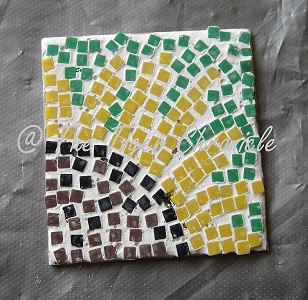
Finally, I gave Tiger a mosaic tile set that I bought from a craft shop.  The set came with ready-cut tiles, a wooden base, ready-drawn design, and grout.  All Tiger had to do was to assemble it.


Tiger actually prefers to make his own paper mosaic rather than to use the ready-made set because:
1) he prefers to draw his own design, and
2) the tiles in the set are all standard 1cm squares, and we cannot cut the tiles easily without making a mess and breaking them.  The inability to cut the tiles results in a less refined finish.


This post is linked up to:
  1. Look What We Did!
  2. Virtual Refrigerator
  3. May Culture Swapper
  4. Creative Kids Culture Blog Hop #4
  5. History and Geography Meme #75
  6. Hobbies and Handicrafts - May 24
  7. Homeschool Mother's Journal: May 24, 2013 
  8. Homeschool Review
  9. Collage Friday - Time for Nothing and an Exciting Something
  10. Weekly Wrap-Up: The One at NCHE
  11. Hip Homeschool Hop - 5/28/13

Friday, 16 September 2011

End of Rome

We are putting an end to Ancient Rome, having been deeply involved with this topic for over a year now.  To be honest, I'm all 'romaned out'.

This week we finally started on The Story of the World Volume 2.  The first chapter is, alas, the Romans!  That serves both as a recap on what we did last year, as well as a logical lead into the era that followed the fall of the Roman Empire.  Incidentally, the second chapter starts to mention Britain (the Celts), which sees us again going through a quick review of Romano Britain.

Our Roman adventures came to an end after we had compelted the following activities:

1) Field Trip
We attended a two-hour handling session at the Museum of London where the Curator of Human Osteology gave us a very detailed walk through of the Roman human remains from the museum's collection, including the actual skeleton of the Spitalfields Lady!  


Using the numerous actual 2000-year-old Roman skeletal parts, the curator showed us how archaeologists and forensic scientists determined the age of the bones, the state of health of the person, what kind of disease or illness the person had, the cause of death, how the bone structures reveal where the illness occured in the body of the person while he/she was alive.


This session was very different from the other history trips we have been on so far because of its scientific focus.  While we have been on several field trips that looked into deaths and burials -- where the emphasis was on using evidence gathered from burial sites and burial goods to determine the living conditions of the deceased -- this was the first time we hear an expert tell us about the scientific aspects of history and archaeology.  We were also told about how carbon dating actually works and what its shortfalls are in terms of exactness in dating.  Apparently when using carbon dating methods, one must give an allowance of +/- 500 years!

2) Roman Food
I made this Roman stew.  The result turned out much like a cross between lentil porridge and a mushy soup.  It sounds disgusting, but both Tiger and I ate it and we thought it was ok.  Not our favourite, but it was edible.  Tiger rated it 3 out of 5, which means he is happy to eat it once but not again.  We got through the meal by imagining ourselves to be Roman soldiers who had been marching for 18 miles that day and were happy to be given mushy food at the end of a long march.  Despite its unappetizing appearance, the stew was extremely filling.  In this sense, it would definitely be an appropriate 'army food' for a very hungry Roman soldier!

3) Review
We worked through all the materials here, as a final review of what we have learnt so far.  For those who are not familiar with the UK mainstream education system, here is a quick explanation of what the term KS (key stages) mean.


This post is linked up to several blog hops, where you can visit to see what other homeschoolers have been busy with.

Friday, 26 August 2011

All About the Romans

Tiger began his history study (both World History and British History) last September.  Even since then, he had been fascinated by the Romans.  We use Our Island Story as our main text for British History.  With this book, after the first two chapters about ancient Britons (basically the Celts), we quickly moved on to the Roman invasion and their 300+ years of occupation in Britain.  From that point on, Tiger was hooked.  He was mesmerised by the Roman army, he wanted to know all about how the Romans lived; we visited many Roman sites within travelling distance to us; he learnt all about the Romans' major battles; he learnt who the major Roman emperors were.....  He became very engrossed in everything that has to do with the Romans.

Hence, we started Year 1 with the Romans.

Our World History text, The Story of the World Volume 1, covers the Romans towards the end of the book.  By the time July came along and we were ready to make the most of the summer weather, we still had Ancient Rome to complete.

Therefore, after our summer break, the only yet-to-be completed part of Year 1 was Ancient Rome.  I really want to start Year 2 in September without anything being carried over from Year 1, so we had an intensive few weeks concentrating on the study of Ancient Rome.

1) Books
Given Tiger's interest in Ancient Rome, it was very easy for him to read all the following supplementary books:


2) Field Trips
a) We visited a gallery of Roman classical sculptures where we spotted the busts of Claudius, Hadrian and Julius Caesar, among many other sculptures of mythical heroes.


b) A walk around the British Museum's Roman Empire gallery and Roman Britain gallery never failed to inspire us to learn more about the ancient times, especially when the visit was enhanced by a knowledgeable guides who told us: (1) a quick summary of the Rise and Fall of the Roman Empire using relevant gallery collections; and (2) all about how the culture and religion of Rome were adapted into the Romano Britain culture.


c) Tiger dressed up as a Roman Legionary when we spent another day in London, visiting the area that was known as Londonium during Roman times.


All that remains of the Romans in this area was parts of what had been a Roman fortress wall.


d) We also watched a show of gladiator games at an arena that was recreated at the exact location of what remained of the only arena in Londonium.  The ruins of the actual arena are now preserved at the basement of the Guildhall Gallery.


While waiting for the gladiator games to start, we strolled along a Roman street where reenactors recreated the atmosphere of Londonium by dressing up in Roman costumes and 'working' at different stores to show people some of the items that were traded in Roman times.


An hour later, the main action started.  I had some reservations about taking Tiger to watch a gladiator game, knowing the violence that it involved, even at a reenactment.  However, at the ticketing office I was told that it was a family show and that children younger than Tiger had attended the earlier show in the day.  Tiger had read about the gladiators but I still felt the need to explain to him that what we were about to see was a reenactment, much like the jousting knights we had watched a few months ago, and that nobody would get hurt in the show, but they had to pretend to be so because they were actors acting their parts.  Most importantly, the 'blood' he would see in the show was actually made from red colouring.

After much prep talk and a "Mum, you don't have to tell me all this.  I knew it already." from Tiger, the 90-minute show began with much fanfare and pomp.  The show was very well done, as I could feel the 'bloodthirstiness' of the spectators, which could be easily extrapolated into the late Roman period when the decline of morality marked the beginning of the end for the Roman empire.

3) Hands-on activities
On a more civilised level, we did a few hands-on activities for this topic.

Back home, I pulled out a Gladiators book to consolidate what we have learnt about this very uniquely Roman phenomenom.  This book, or rather this pack, is more than a book.  Tiger spent a few hours going through everything and learning about the structure of the Colosseum.

Tiger also made a Roman tile and a Roman room.  Tiger has become increasingly independent such that he no longer needs my help putting these items together.  When I offered to help, I was told, "No, thank you.  I know exactly what I am doing."

Related Posts Plugin for WordPress, Blogger...