Saturday, 11 February 2012

The White Blanket

Snow finally came to us in February.  It snowed very suddenly one night, and went through the whole night.  Tiger has been waiting for snow since last December so he was in ecstasy when he woke up the next morning and saw this:

6 inches of snow the next morning.

The unwritten rule in our household is that when there is more than 2 inches of snow on the ground, lessons are off.  Hence, after breakfast we went out to enjoy the snow scene.


Boys being boys, they just couldn't resist rolling around in the snow -- well, my boys, that is.


Once the boys had had enough rolling around, we walked back home.  On the way, we saw a few friendly and lovely animals.


On our way home, we saw a mini digger clearing the snow.  The boys were apparently inspired by what they saw, because soon after we got home they got the shovel and broom out to clear the snow in our neighbourhood.


This post is linked up to several blog hops, where you can visit to see what other homeschoolers have been busy with.

Friday, 10 February 2012

Let's see some real animals!

Since we have been studying animals, specifically classification.  With a view to moving on to vertebrate as a topic, I thought it would be a good idea to actually see some of the animals that we have been studying rather than just learning from books.  The best place to do so: the zoo.

Before we went to the zoo, Tiger completed a revision of classification.  By now I think the basic classification of animals has been drummed so much into him that he is not going to forget it anytime soon.


Now for some real animals!  Since it was a weekday in winter when we went to the zoo, there was hardly anyone else there.  To my surprise, most of the animals were out and about in the icy weather.


Tiger has inherited my old camera lately and has been very eager to use it on this trip.


Although seeing the exotic animals was an eduational experience, Tiger had the most fun petting the pygmy goats and being so close to them.


This post is linked up to several blog hops, where you can visit to see what other homeschoolers have been busy with.  It is also linked to the Carnival of Homeschooling.

Monday, 6 February 2012

East of China: Korea

As we continued our eastward journey in history from China, we arrived at two countries that were heavily influenced by the Chinese: Japan and Korea.  Although I had previously noticed some similarities among the three cultures, I did not know why it was so until I learnt from our world history leson that Korea was once ruled by China, while Japan had sent its citizens to be educated in ancient China.

I could not find any suitable supplementary book on Korea from the library, so we watched the following clips to learn about the history of this country:


Even the popular Korean dish, Bibimbab, has Chinese and Japanese influence.  The Bibimbab is basically a steamed sticky rice dish topped with grilled beef, shredded vegetables and hard boiled egg.  The Japanese influence comes in the form of miso soup.  The very Korean side dish is the kimchi (pickled vegetables).


The Chinese influence in Korean cuisine, apart from an extensive use of rice, is in its tea selection.  Koreans are well known for their floral/fruity tea, especially the ginseng tea.  Tiger loves the Korean date tea.


This post is linked up to several blog hops, where you can visit to see what other homeschoolers have been busy with.  It is also linked up to the Spring Edition of Carnival of Homeschooling.

Sunday, 5 February 2012

An unschooled week: War and Peace (part 2 of 2)

Peace
After a few days of thinking, reading and learning about war, Tiger decided to put aside his warring tactics and to spend some time concocting 'secret formulae' of some kind.  Instead of having him raid my kitchen cupboards aimlessly, I suggested that we consult the following book for ideas:


The book is actually chemistry-in-disguise!  Great!  The lessons are presented in a colourful, child-friendly way, with lots of hands-on experiments with a few straight-to-the-point explanations.  Just the right approach for us at this moment.

1) The very first experiment we made was a garlic oil salad dressing.  There is certainly lots to be said about kitchen chemistry as the process of turning raw food into cooked meals is full of chemical reactions, but we'll just start with the simplest, most easily observed change.


The aim of this experiment is to introduce chemical reactions in terms of changes in smell and taste.  Tiger first smelled and tasted the pure olive oil.  He then peeled the garlic and soaked them in a bottle of olive oil.  After a few hours, he smelled and tasted the garlic-infused olive oil to verify for himself whether any change has taken place.


Following the success of our previous experiment, Tiger was keen to carry on.  He read through the book by himself and chose the experiments he wanted to do in no particular order.  The only condition I gave him was that he had to complete all the (2 or 3) experiments in one topic before moving on to the next topic.


2) Next up was an investigation into the relationship of temperature and density.

2a) We first looked at the how warm air rises by observing smoke rising up from a rolled up tissue paper.  Obviously Tiger had seen smoke before, but this was the first time we thought about this common occurrence in terms of molecules and density, so a good discussion took place about how heat "excites" air molecules, which led to them spreading further away, which in turn decreased their density, which caused the warm air to rise


2b) The same phenomenon was observed in liquid.  The first liquid experiment was one called "Two-Tone Tea".  First we poured ice-cold water to fill half the glass, then placed a slice of orange as a separator, followed by pouring hot tea into the glass.


When the orange slice was removed, the liquids don't mix because of the huge difference in their temperature.


Feeling the difference in temperature between both liquids.
Once the temperature of both liquids started to equalise, both liquids started to mix together.

After 10 minutes - both liquids started to mix together.
After 30 miniutes - both liquids were equally mixed together.
2c) The second liquid experiment was "Brown and White Cocoa", which was another variation to the experiment (2b).

Ingredients.
Make the cocoa drink.
Add milk slowly.
Observe how long it took for the milk and cocoa drink to mix.
3) The next two experiments have to do with surface tension.

3a) First was the "Penny Challenge".  Simply put, the experiment got us to count how many pennies it took to make the water overflow.

Ingredients.
At the start of the experiment: water filled to the brim.
Dropping coins in one at a time.
Note the thin 'film' at the top: surface tension.
It took 22 coins to break the surface tension.
3b) Next is a variation to (3a), in that we repeated the experiement but this time added a squirt of washing up liquid to the water.  The goal of this variation is to test whether liquid soap breaks the surface tension of the water by observing whether a bulge forms on the water's surface.

At the start of the experiment: liquid soap water filled to the brim.
After dropping 21 coins in, just before the water overflowed. Notice that there was no 'bulge' on the water surface.
3c) "Challenge on a Penny".  This experiment was about counting how many drops of water one penny coin can hold, and observing whether a bulge of water formed on the penny.

At the start of the experiment.
See the 'bulge' at 32 drops of water.
At the 33rd drop, the bulge broke.

It has been a productive and fun week with lots of engaged learning.  Tiger is keen to have another unschooled week but I am very aware that we are not doing much of 'basic skills' such as grammar, which I happen to think is very important.  While I acknowledge the importance of being flexible and following the child's interest (which has proved to be a success this week), I also want to make sure that Tiger has his foundational skills well established.  After all, without the previous year's exposure to ancient world history, I doubt Tiger will gain such intense interest in ancient warfare and related topics on his own.  I think we will meet each other halfway: we will continue with what we are doing in terms of academic approach, with an unschooled week thrown into the mix every few weeks.  Hopefully this will path the way for Tiger to gain more independence and control over the direction of his learning over time, while giving me the peace of mind that he is covering all the fundamental building blocks of learning.


This post is linked up to several blog hops, where you can visit to see what other homeschoolers have been busy with.

Friday, 3 February 2012

An unschooled week: War and Peace (part 1 of 2)

This week is a little experimental week for us.  At Tiger's request and also out of my own curiosity, we have been trying out the unschooling approach this week to see how and whether it would work for us.   After a few conversations with Tiger about his behaviour in the past few weeks, I sensed that he is now ready for more autonomy to direct his course of study.  Although he is not ready to be fully independent in his work, he would like to have a partner in his discovery rather than a 'teacher'.

At the beginning of the week, we agreed that this week I would support him in his learning as he took charge of it himself.  I would neither set any time limit on his activities nor tell him what to do or study.  I did wonder whether we would end up with a week of him not wanting to do any academic work but just play all day.  It has turned out to be a pleasant surprise for me.

War
For the first half of the week, Tiger spent his time learning about his favourite topic: war, weapons, troop formations and strategy.  By his own initiative, he read the following books from the bookshelf:


He then compared what he had read with the information in The Kingfisher History Encyclopedia, then informed me of the discrepancies he found.  He then wanted to review the various significant battles of the ancient world so we watched them together before discussing the different strategies used in the various battles that determined their success or failure.  It was a 'review' because we had studied these battles last year in Ancient History. The ancient battles that Tiger chose to review are listed below:

1) The Battle of Salamis


2) The Battle of Guagamela


3) The Battle of Zama


4) The Battle of Issus


5) Romans vs Persians battle


6) The Siege of Tyre


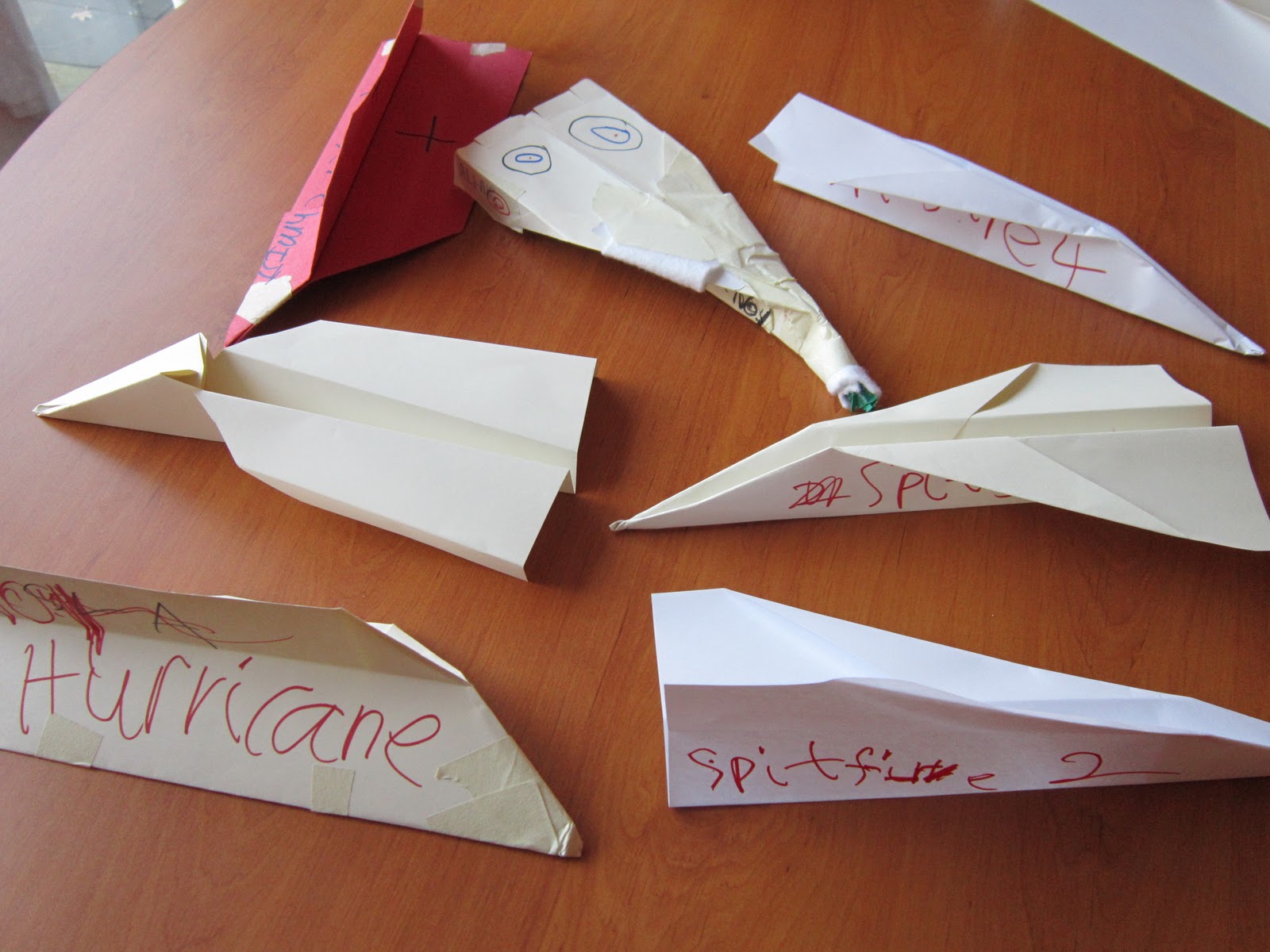
Many 'war plans' and troop formations were then drawn up and reenacted using model soldiers, based on the different strategies Tiger has seen from the documentaries.  Further discussions with Tortoise in the evenings led to modernisation of the warfare, moving us into the era of World War 2 and beyond.  This sparked Tiger's interest in making paper aeroplanes with different designs, figuring out why certain designs worked while others didn't, reconfiguring and remodelling more aeroplanes (our recycling bin is full of unsuccessful designs) until they worked.  For a boy who would have avoided a formal session of origami at all costs, Tiger's enthusiasm and persistence in folding and refolding about 20 different aeroplanes of his own designs was a sight to behold.

A sample of the aeroplanes that have not been 'destroyed in war'.

I suspect the fact that we happened to pass by a military airfield and seeing the take-offs of a few F-15s this week helped to fuel Tiger's interest in this area:


Yes, the first half of our unschooling experiment was all about war, but peace is just around the corner, as we shall see in part 2 of the post.


This post is linked up to several blog hops, where you can visit to see what other homeschoolers have been busy with.
Related Posts Plugin for WordPress, Blogger...