Showing posts with label lesson plans. Show all posts

Friday, 11 January 2013

Cursive handwriting

For a long time, I have debated with myself on the issue of how insistent I should be with Tiger in terms of producing good handwriting.  There are many arguments against pushing handwriting, especially for boys:
  • boys, more often than girls, struggle with fine motor skills required to produce handwriting;
  • boys are less inclined to sit still for the amount of time needed to produce good handwriting;
  • handwriting has become irrelevant and obselete with the availability of word processing software.
While all of the above call for consideration, I still think that there is value in being able to write legibly and beautifully.  Being able to type need not negate one's ability to write a hand-written note should the need arise, and my personal opinion on this matter is that if a child can make a mark with a writing instrument (as an early step to drawing), then forming legible letters and joining them together is only a matter of consistent practice.

With that in mind, we have resumed our cursive writing sessions after having taken some time off from handwriting practice.  We are doing the handwriting sessions twice a week, using Aesop's Fables for Children as the basis for our copywork.


This is how we have been doing the lessons:
  1. Tiger reads one fable to himself, then closes the book and narrates it to me.
  2. I print off the handwriting worksheet and copy in pen the moral of the story.
  3. Tiger copies in pencil as neatly as possible.

The lessons are painless (Tiger hasn't complained about it yet anyway) and takes only 10 minutes each time.  I can see some improvements in his writing after a few lessons.


I would not suggest this method to be applicable to every child.  As always, my best suggestion about handwriting is to observe the child to determine what the real obstacles to good handwriting are.  In Tiger's case, I have seen on several occasions that he can write beautifully if he can be bothered to.  Hence, the real learning for Tiger in this case is more about the importance of patience and applying more care in his work, than about forming letters.

This post is linked up to:
1) Look What We Did: January Link-Up
2) All Year Round Blog Carnival: Winter
3) Enchanted Thursdays Blog Hop #43
4) Weekly Wrap-U: The First One in 2013
5) Homeschool Mother's Journal: January 11, 2013
6) Collage Friday - A Great Start to 2013
7) Share it Saturday - Linky Party
8) The Sunday Showcase 1/12/13

Thursday, 8 November 2012

How Tiger learned to read


Several people have asked me about how Tiger learned to read at 5 years old (he is 8 years old now), so I thought I'd share my reply to them here, in case someone else finds it useful:

(1) Create the environment to support reading.
We have tonnes of books at home.  Books surround Tiger since birth, and we read bedtime stories to him every night without fail, so that got him used to the idea that books contain interesting stories about different people, different places, a different time, and different situations.  Tiger also had near-zero screen time from 0-6 years old, because we believe the screens (TV, computers, phones) are major distractions to a child who has more important things to learn, e.g. reading.  Learning to read requires a certain level of mental discipline, at least to concentrate on 'non-moving' objects such as words and illustrations, so it is best not to have the child exposed to screens with constantly moving images before the child has learned to read.

When Tiger was 2-6 years old, we went to our local library twice a week, each time taking out the maxmimum number of books that we could.  All of us have library cards, so we are able to borrow over 50 books each time.  Besides having me read to him, Tiger also listened to audio books of longer stories such as:
- the complete Winnie the Pooh
- the complete Beatrix Potter
- the complete Roald Dahl

Having the audio books gave me some relief from reading to him all of the time, especially when I was cooking meals.  Tiger listened to the same stories over and over again until he could memorise them, so a few really good ones would be sufficient.


(2) Types of books to read aloud to children
Always go for the original, unabridged version.  They are written in the original complex lanugage that are far more interesting than any shorter adaptation.  When the child is used to listening to complex sentences, he/she will automatically understand them without reservation. 


(3) Learning to read
I used a combination of the Montessori preschool language materials and a book called Teach your child to Read in 100 Easy Lesson by Engelman everyday to formally teach Tiger to read.  Both methods use the phonics approach so they are complementary to each other.  Each lesson took about 15-20 minutes.


Once we got to around Lesson 70 of the book, we started to borrow 'Learn to Read' type of books from the library as part of our twice-weekly library visits.  I then incorporated these readers into our daily lesson.  At the end of each lesson, we spent another 5 minutes reading from these reader books.  First, I would read from the book using my finger to trace under each word as Tiger followed with his eyes.  After I had read it once, Tiger would then read it back to me so that I could check his progress and pronounciation.


The important thing is to have easy access to good books at this stage.  All of our books are on open shelves within his reach so he can help himself to them at any time.  The first book he read on his own was The Iron Man by Ted Hughes.  


It wasn't during our lesson time, but one morning he just decided to take the book and lay on the sofa with it.  This book is mostly words with very few pictures, so I was surprised to find him with it two hours later.  When he put the book back, I asked him whether he was reading it and he said yes.  I wasn't sure whether he really was reading by then, so I "tested" him by asking him to narrate the story back to me, which he did successfully.  That was the start of independent reading for him.  Gradually, Tiger took over all the daytime read alouds for himself, but I have not stopped reading bedtime stories to him each night.


This post is linked up to:
1) Enchanted Thursdays Blog Hop #37
2) Homeschool Mother's Journal: November 9, 2012
3) Collage Friday
4) Favourite Resources: November 9, 2012
5) It's a Wrap
6) Weekly Wrap-Up

Tuesday, 4 September 2012

Don't hang on my words...


or my booklists, for that matter!

I have noticed that, despite deliberately not linking up to any other blogs, and holding it until the very last minute to publish my yearly plan, it has become the post with the highest hit in a single day.  How does that happen?

I am concerned that the plan might give my readers the wrong idea of our intention and approach, so I feel the need to write this follow-up post to clarify a few things:
1) I have deliberately placed emphasis on my intention to apply flexibility rather than rigidity in schedules, completion, "targets", time frames, and resources, which is why I have left many categories open to "various resources".

2) If you have been reading this blog for a while, you would know that even the most beautifully laid out plan of mine does not take long to change.  Last year, I had four months (September to Christmas) before I had to let go of my plan, this year it is changing already -- and we just started Day 1 yesterday!

3) At the back of my mind, I always knew that my published plan is but a back-up, contingency schedule that I fall back on if there is nothing else interesting going on.  Real life, when one is open to its possibilities and experiences, is never dull - at least it has never been dull for us, so I don't actually think that we will have to evoke our contingency plan much at all.  However, that is the only written plan that resembles some kind of structure that we do at home.  As veteran homeschoolers know fully well, actual day-to-day learning doesn't automatically fall into nicely-fit boxes or categories.  More often than not, learning appears (to the untrained eyes) to be slightly chaotic and random, especially for a non-sequential, non-linear learner.

Writing this blog is my attempt to present a framework/structure based on Tiger's learning experience, which in its true form is essentially more organic and much broader than it appears to be on this blog.  You already knew that, don't you?  :-)


Thursday, 12 July 2012

Summer plans


Where has the academic year gone?  Time has just whizzed by and it's summer already!

Tiger's summer looks to be a busy one.... with going over some familiar areas (clay work, woodwork, drumming) as well as venturing new grounds (film/animation, theatre work).  Of course, no self-respecting soon-to-be-8-years-old English boy would spend summer without getting involved in some sort of sports (karate, trampolining, archery, football, tennis, badminton).

When we are not running around outside, I hope we'll spend some time on academic work, just to keep the momentum going so that nobody gets a big shock when it is time to start Year 3, but I anticipate Tiger will spend most of his unscheduled time this summer just playing outdoor, and being with family.

Tiger in his 'den'.
As for me, I'll be spending this summer to...
1) paint and draw;
2) think about and plan for Year 3; and
3) brush up on my domesticity with these books:


This post is linked up to several blog hops, where you can see what other homeschoolers have been busy with.  It is also linked to the All Year Round Blog Carnival - Summer edition and Fun in the Sun Link Up party.

Friday, 3 February 2012

An unschooled week: War and Peace (part 1 of 2)

This week is a little experimental week for us.  At Tiger's request and also out of my own curiosity, we have been trying out the unschooling approach this week to see how and whether it would work for us.   After a few conversations with Tiger about his behaviour in the past few weeks, I sensed that he is now ready for more autonomy to direct his course of study.  Although he is not ready to be fully independent in his work, he would like to have a partner in his discovery rather than a 'teacher'.

At the beginning of the week, we agreed that this week I would support him in his learning as he took charge of it himself.  I would neither set any time limit on his activities nor tell him what to do or study.  I did wonder whether we would end up with a week of him not wanting to do any academic work but just play all day.  It has turned out to be a pleasant surprise for me.

War
For the first half of the week, Tiger spent his time learning about his favourite topic: war, weapons, troop formations and strategy.  By his own initiative, he read the following books from the bookshelf:


He then compared what he had read with the information in The Kingfisher History Encyclopedia, then informed me of the discrepancies he found.  He then wanted to review the various significant battles of the ancient world so we watched them together before discussing the different strategies used in the various battles that determined their success or failure.  It was a 'review' because we had studied these battles last year in Ancient History. The ancient battles that Tiger chose to review are listed below:

1) The Battle of Salamis


2) The Battle of Guagamela


3) The Battle of Zama


4) The Battle of Issus


5) Romans vs Persians battle


6) The Siege of Tyre


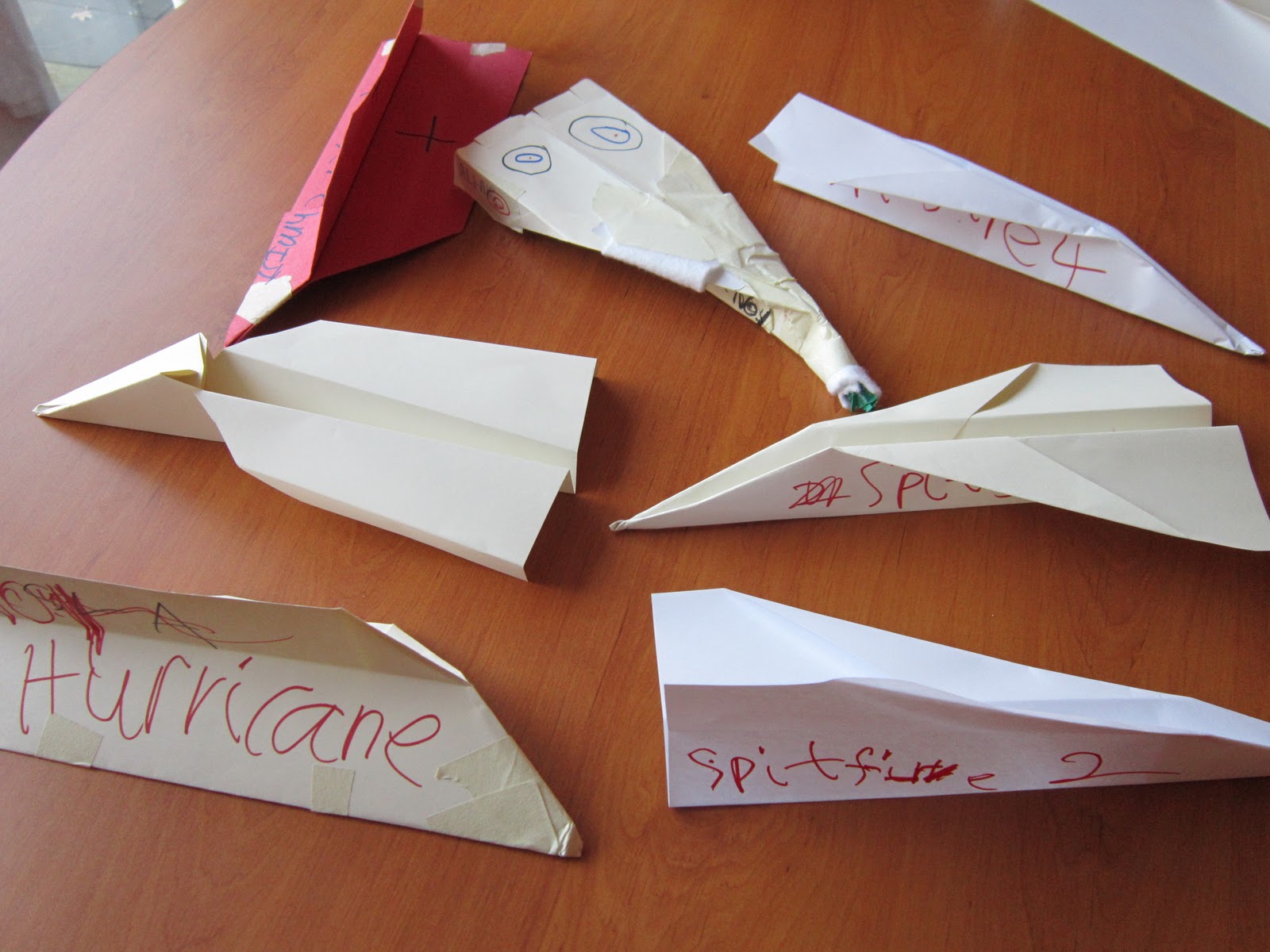
Many 'war plans' and troop formations were then drawn up and reenacted using model soldiers, based on the different strategies Tiger has seen from the documentaries.  Further discussions with Tortoise in the evenings led to modernisation of the warfare, moving us into the era of World War 2 and beyond.  This sparked Tiger's interest in making paper aeroplanes with different designs, figuring out why certain designs worked while others didn't, reconfiguring and remodelling more aeroplanes (our recycling bin is full of unsuccessful designs) until they worked.  For a boy who would have avoided a formal session of origami at all costs, Tiger's enthusiasm and persistence in folding and refolding about 20 different aeroplanes of his own designs was a sight to behold.

A sample of the aeroplanes that have not been 'destroyed in war'.

I suspect the fact that we happened to pass by a military airfield and seeing the take-offs of a few F-15s this week helped to fuel Tiger's interest in this area:


Yes, the first half of our unschooling experiment was all about war, but peace is just around the corner, as we shall see in part 2 of the post.


This post is linked up to several blog hops, where you can visit to see what other homeschoolers have been busy with.

Monday, 30 January 2012

A few things I have learnt recently

As I learn from reading articles, blogs, books and websites regarding my son's evolving developmental/learning needs, I am more convinced than ever that each child's situation is unique.  There are many interacting dynamics that come into play to create that certain situation -- factors that need to be considered together yet separately in order to find an appropriate response.  I am listing some of my findings here in case they help anybody.  Please note that the following are based on my own observations pertaining to my particular circumstance.  I do not pretend to be an expert about anyone else's situation and have absolutely no interest in telling anybody how to parent their children.

1) Assess all environmental factors that might have given rise to a change in the child's behaviour and/or attitude.
Sometimes as parents faced with challenging behaviour in our children, it is easy to try to solve the immediate and most obvious problem by pinpointing the child's difficult behaviour.  However, that will only treat the 'symptoms' rather than the cause of the problem, especially for young children.  Young children often do not have the means to communicate their frustration/dissatisfaction; they may not even understand what is causing them to misbehave or why they are misbehaving.  A perceived difficult behaviour in young children is often a call for help.  Something is out of balance for the child.  It is up to the adult to pay attention and look into all possible environmental factors (for example family situation, social relationships, diet, daily routine and structure, etc) that may be the source of imbalance in the child's life at any moment, and try to rebalance it.

In our case, I used the elimination process by going through the list of possible factors in my mind, from whether there is any tension in my marriage (there is none, luckily) to whether we need to adjust our daily routine.  By eliminating the non-contributing factors, I was able to narrow down the causes to a few that really mattered and thereby find the solutions for them.


2) Rely less on labels, more on your personal observations and common sense.
I find labels useful to the extent that: (1) they tell me that my situation is not new or an isolated case, and (2) someone has looked into similar situations and may have suggestions worth considering.

The danger with labels is that they are very restrictive and are very often misinterpreted/misused.  For example, I really don't care to have Tiger labeled as 'gifted'.  I'm more interested to support him as the child he is, regardless of whether he is 'able and talented' or not.  My commitment is to him, not to any label.

Sure, people have asked me whether I have had Tiger tested and I have considered that in the past, especially in his preschool years when he was doing many exceptional things that were not normally observed in children of a similar age.  However, as I read through all the literature written on the topic of 'gifted children' I could find from the library, there is no doubt that Tiger's behaviour is close to a perfect fit of the descriptions in the books.  I don't think I need to spend a few thousand pounds just to have someone affirm to me what I already know about my own child.  What I need are practical advice and suggestions on how to best support my child.  No doubt that the hefty testing fees would include some kind of suggestion but they are usually geared towards solutions for school-going children, and honestly I don't think they can suggest anything that either (1) I am not already doing in our homeschool, or (2) someone hasn't already written extensively about in books.  So back to more research.

The recurring themes I have learnt from the 'gifted children' literature that are relevant to their academic provision are:
  • flexibility
  • increased breadth and scope of the topics
  • personalised curriculum
  • acclerated learning
  • differentiated learning
  • increased variation of instructions and learning opportunities
After assessing what we have been doing in our homeschool in terms of learning opportunities and materials, I am happy to report that the above criteria have all been met in our little homeschool.  Nearly all the books I have read are variations on the same theme.  This is the reason I have cancelled my order of the Edision-Trait book mentioned in my previous post.  As far as academic provision is concerned, we are right on the mark.


3) Don't lose sight of the child as a whole human being.
This third point follows closely to point number 2, especially if parents get too caught up with the labels given to their children.  As a family (Tortoise, Tiger's grandparents and I), we take the position that while we are happy that we don't have to worry about Tiger's intellectual capability, we believe that above all that, he still needs to be a balanced, well adjusted human being who contributes positively to our world.  Tiger is aware of his own intellectual abilities but nobody in our family gushes over him or tiptoes around him because he is 'gifted'.  He is expected to show respect, learn self-discipline and self-control, have good manners, learn to live harmoniously with others, learn to work with people of different abilities, know right from wrong, work hard, take responsibilities for his own actions... much the same as what other normal children are reasonably expected to learn as they grow up.

I find that many literature on 'the gifted' seem to skew towards explaining away difficult behaviour in 'gifted children' as some kind of expected by-product of their intellectual ability.  I don't subscribe to this theory.  It sets people up to expect neurotic and awkward behvaiour from those who think differently, as well as to assume that high intellect and social graces are mutually exclusive.  I personally think that being smart (through exceptional academic training) is only one of many parts of the equation to having a happy, successful life.  The thing that troubles me greatly about most of the books I have read so far about 'gifted children' is how they have overly empahsized the importance of developing such children's intellect at the expense of considering the other factors that are necessary to achieve overall fulfilment in adulthood.  The only person whom I have found to take a more pragmatic view (in my opinion) is Dr. Joan Freeman.  She is not very popular with parents who like to gush about their gifted children and cannot bear the thought that it takes more than being super smart to succeed in life, but her observations and theories certainly strike a chord with me.  Her book, Gifted Children Grown Up, is a sobering read, especially to those who desperately want to believe that a strong intellect is the single most important guarantee of a successful adult life.  If you can stomach the idea of reading real stories of unsuccessful 'geniuses' and why they fail, this book or a more recent one will open your mind to a number of seldom-considered factors in terms of supporting gifted children.


4) Be patient.
Sometimes the issue ceases to exist after a short while, especially when it has to do with a child's development.  Children often have their own timing with things.  Forcing children, or anybody for that matter, to do something that they are not ready for is counterproductive.  What seems to be an incompatibility in terms of educational approach or materials can simply be a matter of giving the child time to grow the necessary (motor) skills or interests or aptitude to perform those tasks effectively.  I have found being patient with myself (in terms of understanding a situation and my child's needs) to be very helpful too.  Sometimes there is nothing else you can do about it except to wait.  To me, such waiting time is not a period of passive inactivity but one of engaged gestation.


I have implemented a few changes based on what I have learnt so far -- I'm still learning, as you can tell from the books in my reading page.  Since learning is a continuous process of change for us, I will share our story as we go along in the hope that it will be relevant to some of you.

Saturday, 21 January 2012

Time to pause and rethink

Just as I thought we were on the roll in our little homeschool with plans, schedules, etc, something else has been brewing in the background....  My son has shown me, yet again, that he is a child who is still growing and evolving.  The comfortable application of a very structured, mum-led approach of Classical homeschooling that I thought we have finally settled into for the past 18 months now shows signs that it needs to be reconsidered and/or tweaked to better meet Tiger's evolving learning needs.

The rigour and structure of the Classical approach appeal to me, and Tiger was happy for me to take the lead most of the time so we had a good time while picking up many interesting knowledge such as learning all about the ancient world, and learning Latin.  While I was not entirely sure whether Tiger could keep up with the rigour of this approach, he has shown me that he is capable of achieving more than the standard when required.  While we follow the structure very closely, I am not an unreasonable mum, so I have let Tiger spend more time on topics that captured his imagination, such as everything-about-ancient Rome.

Year 2 started off well, but by last December Tiger started to show signs of "underachieving" (for lack of a better word) -- easily distracted, having to move constantly during lesson time, unable to listen, moody, just doing the minimum required at any time, unmotivated... generally very unpleasant to be around. Having read many scare stories about boys being underachievers in mainstream schools, I thought I was witnessing a nightmare unfolding before my eyes.

For example, recently he wrote the following note to me just before our usual Latin lesson:


Being in one of my pushy-mum moments, I read the note, left it on the table and said to Tiger, "We'll talk about this after the lesson."  I thought that maybe Tiger was feeling the pressure of not being able to understand the lesson.  To my surprise, he got through it quickly and perfectly!

Tiger wanted to put ten stars, but we stopped at six.
Tiger was all smiles when he saw his score, and could not wait to show the paper to his dad when he got home.  I pointed out that he would not have experienced the joy of his success had we given up without trying.  I only said this because I know what Tiger is like.  His ability to achieve coupled with (what I perceive to be) his unwillingness to try or work hard are what I find annoying yet distressing.

After talking with Tortoise about the challenges I have been facing in our homeschool, and searching for answers on the internet, I came across a post from Suji, who had had to rethink her homeschooling strategy a few years ago, following an evolved learning need of her son.  Suji's post made me look deeper into the concept of a divergent learner, as Tiger seems to be showing many of the traits described.  I already know that Tiger is more of a visual-spatial learner so have tailored his learning materials to suit this particular style, but obviously now I need to learn about this new learning style of his and adapt to it.

Interestingly, having read a little about how divergent learners learn versus how convergent learners learn, it is clear that Tiger and I are polar opposites in how we learn, which explains why it has been so difficult for me to understand why he struggles with things that are extremely straightforward and logical to me.  Luckily for Tiger, his dad (Tortoise) is largely a divergent learner so at least he has been receiving sympathy and understanding from that camp!

A very convergent-learning mother having the job of homeschooling her increasingly divergent-learning son.  This is going to be very interesting.

At this point, I am still doing my research and absorbing the new information that I have found so we have changed neither our curriculum nor approach.  Intuitively, I think the solution has less to do with changing specific learning materials but more to do with how we use them.  However, now I can at least empathise with Tiger's struggles, and make adjustments as I learn more about this new phenomenon.

At times like this I fantasise about how blissful and easy my life would be if I had a more easy-going child who just follows whatever directives I give him.... But wait!  That will actually make my role no more than that of an assembly line worker putting together a pre-specified output.

That's certainly not how I'd like our homeschool to be.  It'll be a worse nightmare than having to respond to the continuous natural development of my child.  I'd much prefer to think of our homeschool as an art studio where the working process isn't always tidy and predictable, and we don't always know when we'll have to make changes in our process.  However, in an art studio we have the possibility of creating a beautifully unique piece of art, whereas in an assembly line all we'll end up with is a mass produced, standardised product with very little indivdual personality left.

Having said this, I'm still in the process of figuring all this out.  I'm waiting for this particular book to arrive in the post soon.  It may shed some light on the matter.  My son certainly keeps me on my toes and makes my life very interesting!

Tuesday, 17 January 2012

More tangrams

Since we have had such fun with tangrams previously, we continued working with working with forming numbers with the seven pieces.

We started with Tiger forming various numbers as best as he could, without referring to the 'answers' provided in the lesson plan.

Five
Ten
Two
Zero
Four
After Tiger had formed the numbers in his own way, we looked at the 'answers' to compare Tiger's numbers with the suggested answers.  I do not know whether there is a right way or wrong way to form the numbers using tangrams -- I assume that there isn't only one right answer -- so I only refer to the ones given in the lesson plan as suggestions rather than the only way to solve the puzzle.

Looking at the answers was helpful in giving Tiger ideas on how to use the pieces in different ways to form the same numbers.


Compared to his approach, the answers given focused on forming the numbers in a more enclosed manner.  Tiger then formed the numbers again, this time following the examples given.

One
Zero

Two
Four

This post is linked up to several blog hops, where you can visit to see what other homeschoolers have been busy with.  It is also linked up to Math Teachers at Play blog carnival #48.

Wednesday, 23 November 2011

On teaching art: pre-workshop views

How much 'learning to draw' do I want to do with Tiger?  This question has been on my mind quite a lot lately.  Thinking out loud often helps to untangle the problem, so bear with me while I try to resolve this.

This year, I have made a conscious effort to devote time in Tiger's curriculum to art, specifically in the area of artist study.  So far we have made good progress by combining picture study, field trips and hands-on activities to learn about the styles of each artist.  The sessions have been fun, and have increased our exposure to different artistic styles and materials.

The trouble is, I am not entirely happy with the quality of the output produced in those sessions.  I am wondering whether setting aside time to teach Tiger the fundamentals of drawing will help him produce higher quality pieces?

I belong to the School of Realism, or Representational Art.  I admire skilful draughtsmanship; the Old Masters are my heroes.  I can go as far as Expressionism and Surrealism, but Abstract Art is not my cup of tea.  I don't accept people just splashing paint everywhere and calling themselves 'artists', or displaying rotting food with maggots and calling that 'modern art'.  I have a lot more respect for art work that shows skill, thought, and meaning.

That's just me, and what I expect of my own creative pieces.  That's why I put myself through the rigour of Life Drawing classes and workshops.

However, I am not sure whether it is appropriate or necessary to introduce actual drawing lessons to Tiger at this stage, even though I am sure that his art work will improve tremendously with better drawing skills.

The reason for my hesistation is that Tiger is always happy with his final output.  If he were not happy with any aspect of work, he corrects it before it is completed.  While I uphold high quality work, I also believe it is very important for the artist to be happy with his own work.  Being happy and confident about his own work is crucial for him to enjoy the creative process and to want to do more.  Everytime I feel like commenting on his work, I remember how Van Gogh's work never received any recognition during his lifetime.  While I am not comparing Tiger to Van Gogh in any way, I am conscious of not putting his creative efforts down based on my personal preference for a different artistic style.


Also, I did not start drawing until about 3 years ago.  That was because I was constantly told, as a child, to draw or paint in a certain way so as to reproduce the art work in the 'textbooks'.  That killed all enjoyment of the creative process for me for a very long time, so I try not to do that to my son.

Up to now, Tiger has been doodling happily at different times of the day, as and when he feels like it.  I don't want to be a kill-joy.  At the present moment, it is more important that Tiger freely expresses himself in art than to draw like Michelangelo.  If he wants to learn to draw realistically, he will let me know.

There.  I am going to put my copy of Drawing with Children away now.

Incidentally, I will be attending an creativity workshop for art teachers in a few days.  The goals of this workshop are:
  • To explore how drawing can encourage more varied and flexible modes of thinking
  • To widen perceptions about what creativity involves
  • To use drawing as a key to developing creativity across the curriculum
  • To enable drawing to be taught more confidently and creatively
I expect my views on creativity and teaching art will be informed/influenced/shaped, or even challenged, by attending this workshop.

Sunday, 18 September 2011

Down the rabbit hole

This year I am determined to put things right about how science is learned here.  Last year it was done in a haphazard manner which has not been very effective in helping Tiger to become more knowledgeable in this area.  This year we are using MSNucleus, starting from the beginning -- kindergarten level.

We are starting with the Life Cycle (this curriculum's equivalent of Life Science).  So far so good.  We covered classification.


After reviewing the most fundamental classification of living versus non-living things and reading the book shown above, we proceeded to hands-on classification of wild animals using plastic model animals that Tiger used to play with.

It was interesting for me to observe how Tiger went about putting the animals into groups and to hear his logic behind the groupings.  Having Tiger explain how to arrive at his way of doing things is an effective way to understand how he thinks, and for me to assess how much he knows about a given topic or concept.

After spending a few moments discussing the factors that may be used to classify the animals, such as diet, size, habitat, physical attributes, I let Tiger loose to work on it himself while I observed how he went about it.

He first separated the whole lot into two big groups, then I challenged him to classify them into smaller groups after each separation.  His final result was as follows, which I then summarised into a diagramme so that we could both see what was done.


Everything was going great until the end of lesson 1 when Tiger and I discussed the native habitats of a selection of wild animals.  I was not expecting too much from our discussion since I am well aware of how little time we had spent on science before, but I became worried when Tiger did not know where elephants are from, and did not know that you don't find lions and tigers together in a jungle. Alarm bells started to go off in my head as I experienced a private "I-have-failed-my-child" moment.

Never mind this 6-year-old can tell me details of every major battle in the ancient world and in British History up to the War of the Roses -- who fought against who, how long the battle went on for, where the battle was fought, who won, why and how they won, what weapons were used by each side.... I still panicked, albeit momentarily, when I saw what resembled a "Do you know where milk comes from, children?  Yes, Miss, milk comes from the supermarket shelf" situation.  I'd say spending more time getting to know the various habitats/biomes is in order at this point.

After some scrambling around again, I discover that there is so much to learn about habitats/adaptation/biomes.  It seems that this topic alone is going to take us quite a while to study.  In the process of gathering materials and resources, I realise that this is turning into a unit study, or maybe calling it 'theme-based study' might be more appropriate.  My 'plan of attack' is loosely outlined as follows:

1) Hands-on Activities
2) References (books, websites, documentaries)
3) Games
3D World Animals Floor Puzzle (this is a 'leftover' from Tiger's preschool days that we are now using as a springboard for discussion)
    4) Field Trips
    • A zoo
    • Natural History Museum 
    I don't know how long we will spend on this topic before we resume lesson 2 in our science curriculum, but I am inclined to enjoy learning as much as we can about this topic and see where else our interest (or in this case, a knowledge gap) takes us, rather than to worry about ticking the boxes of an arbitrary sequence set by someone else.  We are doing it our way, and I'm really excited about it.

    This is probably our first deviation from our very structured, "Classical" style.  Does that matter?  I don't think so.  I am not even sure what grade level we are working at for this, but knowing grade levels and following strictly to any specific homeschooling style are not important anymore; it's what we have actually learnt that counts.


    This post is linked up to several blog hops, where you can visit to see what other homeschoolers have been busy with.

      Wednesday, 31 August 2011

      More about Science

      Another thing that has got me really excited about science for the coming year is finding extra science resources to use.  I have not been too happy about science last year, so we will be focusing our efforts on this subject area this coming year to regain lost ground!

      There are many resources out there that are good in their own ways, but I am specifically looking for those that meet the following criteria:
      • experiments that are fun, easy to do, and use easy-to-find materials;
      • the rational behind the experiment results are explained (that was one shortfall of the science book we had used in the summer -- it had many experiments but no scientific explanations of the hows and whys);
      • makes a connection between theory and everyday applicability;
      • inexpensive;
      • follows the topics set out by The Well-Trained Mind
      I have found the Science for Every Kids series by Janice VanCleave to meet many of the criteria above.  We will be using three from the series (Biology, Earth Science, Astronomy) this year.

      This series is good for experiments and explanation, but they are not workbooks with spaces for the student to write or record any observations in.  Even though these are 'extras' in our science area, I would still like to see Tiger being more involved in the learning, recording and thinking of the experiments than to just have passively have the answers presented to him (via the books).  Therefore, we will be using the Drawing and Notes/Definitions page, and the Experiment page from here along with each experiment.  Since Tiger is not too keen on writing just yet, I expect I will be writing down Tiger's narrations for these science sessions, which is the same approach as we have been using for other subject areas such as history and writing so far.  Gradually, towards the end of next spring, Tiger will be expected to take over the writing for himself.

      And when will we do all this, on top of our main curriculum?  Since these are fun topics and extras, we will just spend an hour or so per week on them.  I am not planning on completing each book by the end of next summer.  The idea is to do one or two experiments from each book at our weekly 'extra science' session.

      In addition, Tiger has been begging to do a Science Fair.  I think he got that idea from The Berestain Bears.  I have never been to a Science Fair, much less participate in one!  But, can anyone say no to a child who begs to have a go at doing science?  I can't.

      Luckily Janice VanCleave has a Guide to the Best Science Fair Projects that I think would suit beginners like us.  I had a quick glance through the book when it arrived.  Tiger is probably still too young to write the project reports and to provide a full blown scientific explanation but we have to start somewhere, don't we?  Looks like this is yet another area in which both of us will learn together, since the whole idea of Science Fair is new to me as well.  We will take this slowly by taking on one project each month.

      This leaves us time to build our skills alongside our portfolio of projects, so that when an opportunity for open-minded, real learning and friendly exchange of knowledge comes up in the future, Tiger will be ready to showcase his work.
      Related Posts Plugin for WordPress, Blogger...