Showing posts with label Medieval England. Show all posts

Friday, 24 April 2015

In Hot Pursuit

Following our recent study of Sherlock Holmes, Tiger and I decide to keep up the interest in all things mystery.


I chanced upon a company that sells various themed mystery/treasure trails around the country.  The trails look quite interesting and challenging, and appears to offer a fun day out, so we tried out the one that is set in Convent Garden area.


Tiger was keen to take the lead for solving the mystery.  The trail is designed such that we are only told the starting point (this particular trail started outside the Leicester Square tube station), and have to find our way around by following the clues given in each step of the trail, which are in turned only revealed when we solve each cryptic code accurately.  We thought it would be very easy, but we realised that we were totally lost after three hours of walking around the side streets and narrow lanes in the Soho/Convent Garden vicinity and finding ourselves barely halfway through our trail.  The guideline on the trail says that it should take 1.5 to 2 hours to complete the trail.  Ooops.

Feeling very hot, bothered, and utterly defeated, we gave up for the day and went home to rethink our strategy for solving the mystery. 

We returned to complete the trail the next day, this time better prepared, both mentally and physically.


There must be something about wearing the Yorkshire flat cap that invoked Tiger's inner detective, as we were much more successful on our second attempt to complete the trail and hence solve the related mystery.  It took Tiger less than an hour to this time, and as we ended up in Convent Garden Market where there are many interesting sights to be seen, we spent the rest of the day congratulating ourselves for being super sleuths and rewarding ourselves with fantastic food found in the market.

Encouraged by our success at the Convent Garden trail, we then spent another fun day solving a second murder mystery, this time at Bankside.  I chose this location thinking that we would have a greater success because it has a shorter completion time of 1.5 hours, and that having been to that area many times we ought to know most of the places there.

Not wanting to take any chances this time, Tiger started studying the trail and working out the most efficient route once we got on the tube to get our first destination.


Our starting point this time is outside the London Bridge tube station, near the Southwark Cathedral.  This proved to be very interesting for me because we had mostly hung out on the St. Paul's Cathedral side of the river, so starting the trail from Southwark is an opportunity for us to explore a few new places.


And exploring and discovering new places we certainly did!  The trail took us through many significant, new-to-us landmarks that we did not know about or had not visited before.  Seeing new places is always exciting, especially when it is done in conjunction with delicious food, as we found when we were led to Borough Market.


It was Tiger's first visit to Borough Market, and the sights and sounds of the market fascinated him.  More importantly, we found a stall that sells Thai desserts and mango sticky rice which we both love to eat!

The trail gradually led us towards the side of the Thames that we are more familiar with, whereupon we walked past the Clink Prison Museum and Tiger wanted to go in to take a look.


I knew about this museum but did not take Tiger here for a visit when we studied Medieval England because I thought: (1) it looked more like a commerical attraction than a real, historical accurate museum, and (2) the content may be too gruesome and hence inappropriate for a young child.  However, I was pleasantly surprised to find that not only are the exhibits and artefacts historically accurate, the representation of this gruesome aspect of medieval history is not unnecessarily gory.  Tiger was fascinated by the exhibits, while I was slightly appalled by the inhumane use of certain instruments of punishment.

As we approached the end of the trail, we were brought to 'theatre-land' (at least in Tudor/Elizabethan times) and came upon the original site of the Globe Theatre, which was burned to the ground.  Although Tiger and I have visited the current Shakespeare's Globe theatre many times in the past, we have not been to the original site until now.  It is interesting to see that the site is now part of a compound inside a housing estate.  Not far from it stands the Rose Theatre, which was the first purpose-built theatre on Bankside (predating The Globe Theatre) in Tudor time.


We walked the trail at a very leisurely pace, so it took us nearly a whole day to complete it but we stopped and enjoyed our discovery of many previously unknown-to-us places as the clues took us down side streets or made us look closely at certain architectural and historical features along the way.

Thursday, 18 September 2014

Heaven! (for a military history buff)

By looking at my plan for Tiger this academic year, it may appear to many that I am overriding his  interest in military history, or that I am abandoning the interest-led learning environment that dominated our household last year to a more classically-driven environment.  Contrary to these appearances, my goal this year is to find a way forward to amalgamate both approaches to provide Tiger with a rigourous foundation in his area of interest.

It seems that military history is here to stay for the foreseeable future.  To bring the life the information in the books that Tiger has read,


I took Tiger to a military machines and vehicles show to look at and touch the various machines up close and to talk to those who are as keen on this subject as Tiger is.


There was so much to see that we spent a whole day (10am to 6pm) there.  Never in a million years would I have thought I would attend such an event, but there you are, I was there walking around the grounds with my boy for eight hours.

There were so many different military vehicles on display that the many hours we spent were necessary just to look at everything.

A sample of the military vehicles on display.

The best thing about going to such a show is that the vehicles are not static displays but are actually in excellent working conditions so we could see them in action:


I was amazed at how fast some of these tanks can go, so I really appreciate being able to see them in action.


Besides watching the tanks and other military vehicles roll by, Tiger also got to go on a 'tank ride' (it's really an armoured personnel carrier).


Tiger really enjoyed the experience, although he admitted that ride was very bumpy and rather uncomfortable when compared to riding in a normal car.


There were also many soldiers' tents set up to depict the weapons and machinery used in different regions/conditions or in different historical periods:


With bombs and weapons at one end of the conflict, at the other end we find the Anderson shelter.  The one on display there was kitted out inside so we could get a really good idea of the amount of available space inside the shelter:


The site was roughly sectioned into different areas of:
  • land vehicles
  • air vehicles
  • shelters
  • tents
  • weaponry

In the weaponry section we saw many different types of guns and explosives, including land mines.


Many of the displays could be touched and felt, so Tiger had a good time working his way through the various types of guns.  I was fumbling about with a hand gun at a stall where different guns were taken apart and the event-goers were challenged to put them back together, not quite sure which part goes where, when Tiger decided it was too painful for him to watch his mother struggle with it so he asked, "May I show you?"  I promptly passed the gun over to him and watched him assemble it together and showed me how to hold it, load it and fire it, all under 30 seconds.  I don't know where he's learned how to do this but I'm guessing it's from all the military books and documentaries he has watched.


Interspersed with the moving vehicles display were reenactments of battle scenes throughout history, which helped us understand the development of warfare tactics as a result of the advancement of weaponry.


It started off with guns in the Hundred-Year War:


Then the next big leap forward in technology came in the First World War when the British developed the Mark IV.


Tiger has read about the Mark IV tank in the various historical books but this was the first time he came up close to it, to be able to touch it, walk around it, look inside it, and best of all, to see it in action.  Although the Mark IV is very slow compared to the modern tanks, it must have been a terrifying sight to the soldiers 100 years ago when they had never seen anything like it before:


Closely associated with the First World War is the trench warfare.  We saw a few "desmontration" trenches on site. These were not the full size trenches of the First World War but they gave us some ideas of the equipments used and the hardships endured by soldiers who have to fight in that condition. 


From the First World War, we moved on to the Second World War.  The majority of the vehicles and machines we saw on site were from WWII.


We also wtached a reeanctment of a WWII skirmish between the British and German troops:


The reenactment went on for about half an hour and gave us a realistic idea of what the numerous WWII skirmishes might have looked like:


While the majority of the displays were land vehicles, we did see a few planes and helicopters.


What we saw, which we haven't seen anywhere else, was a working life-size plane engine:


It was a very long day but Tiger came away at the end of it saying that it has been his best day out so far.  Tiger's love affair with military history continues.  All I can say is that I am grateful to find such opportunities where Tiger's keen interest is supported and where he can meet and talk with fellow enthusiasts to his heart's content about something that both my husband and I aren't particularly knowledgeable or enthusiastic about.


This post is linked up to:
  1. Hip Homeschool Hop - 9/16/14
  2. Finishing Strong #29
  3. History & Geography Meme #135
  4. Home Education Blog Link Up #15
  5. Collage Friday - A Well Rounded Homeschool
  6. Weekly Wrap-Up: The One Where I Officially Have 3 Teens
  7. The Homeschool Mother's Journal (9/20/14)

Monday, 10 March 2014

The Other Scottish King: Robert the Bruce

England feud with Scotland started with Edward I's compaign against Scotland and continued into the reign of Edward II.


While Edward I was pitted against William Wallace, Edward II's nemesis came in the form of Robert the Bruce.


Robert the Bruce's rise to power wasn't straightforward, as he had to contest with his Scottish rival, John Comyn, for the kingship.  He eventually murdered John Comyn in the process.


Robert the Bruce's greatest victory against the English was at the Battle of Bannockburn.


After watching the videos, Tiger was inspired to make a Scottish armour out of a few pieces of red cloth, aluminum foil, and some masking tape.


Naturally, there has to be an epic battle to put the armour to good use.  This time Tiger took the role of  a Scot who was killed by the pike on the battlefield.  It has taken a few years of mock battles for Tiger to be able to take on the role of one who is defeated.  Compared to the previous few years when he felt absolutely invincible (or that he could never be wrong about anything), he is starting to show some maturity and awareness of his own ego, and is ready to acknolwedge that he, like everyone else, has some areas of weaknesses.


This post is linked up to:
  1. History and Geography Meme #107
  2. Hip Homeschool Hop - 3/11/14
  3. Entertaining and Educational - Art Masters 
  4. Collage Friday - Homeschooling Girls and Boys
  5. Weekly Wrap-up: The One with Cat Surgeries and Early Mornings
  6. Homeschool Mother's Journal (3/15/14)

Friday, 7 March 2014

A Royally Dysfunctional Family

The life of Edward II, son of Edward I, seems to be quite dysfunctional, as shown in the following documentary (from 16 to 22 minutes):


His close relationship with Piers Gaveston is a source of much speculation about both men's sexuality, although some scholars believe that there is no conclusive evidence to support it, since both men married women and had children in their respective marriages.

Nonetheless, the two men's closeness (and Edward II's comparative political incompetence compared to his father) incurred the wrath of the barons and Edward II's wife, Isabella of France (see the first 31 minutes of the following documentary):


The deposition of Edward II by his queen, Isabella (with the help of her lover, Roger Mortimer), was at that time, unprecedented and unimaginable, especially if one considers the position of the majority of women in the Middle Ages.


Friday, 21 February 2014

Battling with the Welsh

Before Edward I became "The Hammer of the Scots", he went hammering at the Welsh.  The way that he went about having an upper hand over the Welsh was to build a formidable fortress in the form of Conway Castle.

Given that the castle had been built for the purpose of battle, we were curious to about how its structure provided a strategic advantage to Edward I's victories over the Welsh. 

The Battle Castle series appears to be just what we need to learn about this.


I bought the DVD set and we've learnt loads watching the episode that is dedicated to examining Conway Castle.  After watching the documentary I thought we ought to do something hands-on, so I suggested that we build a model of a castle.


Tiger wanted to have reenactment battles with his model knights instead.  I am not a big fan of playing with model knights, to be honest.  Believe me, I have played with model knights and soldiers to reenact many, many, many (to the power of n) battles, from the ancient times to modern warfare.   Far too many than should be reasonably expected of a normal mother, really.


After my troops had surrendered (experience has taught me that it's the only way I could end the battles), we calmed ourselves down by making the model.  Homeschooling in this household involves much negotiation and give-and-take on both sides.


I used the model making sessions to have Tiger tell me what he has learnt about Conway Castle from the documentary that makes it a stronghold for Edward I's Welsh campaigns (in addition to Caernarfon Castle), its significant features, and how it compares to the 'standard' castle model that we were putting together.


The model was quite fiddly to put together, due to its many small parts and lack of assembling instructions.  However, we managed it in the end.  It's very satisfying when our models work!


This post is linked up to:
  1. Hip Homeschool Hop (2/18/2014)
  2. History and Geography Meme: Country Studies
  3. Collage Friday - Flip Flops and Challenge on Winter Break
  4. Entertaining and Educational: National Engineer's Week
  5. Weekly Wrap-up: The One with the Cheek Cells
  6. Homeschool Mother's Journal (2/22/14)

Thursday, 21 November 2013

Warwolf

During our visit to the Tower of London, we saw a reenactor dressed up as a medieval priest who gave us an overview of the history of the Tower as a royal palace, a prison, and a fortress.  A full-sized replica trebuchet was on site to demonstrate the power of this medieval siedge weapon.  It took five adults to launch the trebuchet.


The trebuchet is of special interest because the weapon has been traced back to being first used by Edward I during his siege of Stirling Castle.

While Tiger and I discussed about medieval siege weapons, I was given a quick education by Tiger of the differences between a trebuchet and a mangonel.  If your knowledge of medieval weaponry is like mine, i.e. that you think all catapulting machines work in the same way, you will benefit (as I have) from watching the two clips below:

1) Trebuchet


2) Mangonel


We learn much about the trebuchet from the following clip:


Why do we want to know so much about the trebuchet?  The main reason is that Tiger is passionate about everything that has to do with warfares and weaponry, historical and otherwise.  After hours of listening and watching experts talk about this medieval war machine, we decided it was time to build one ourselves.


It took us a few days to put the trebuchet together...


and when it was fully assembled, all of us thought it looked beautiful!


Naturally, we had to test whether it to see how good it is.


Unfortunately, our first few attempts at launching the trebuchet didn't go too smoothly.


The projectile either didn't go in an arc path, or was trapped in the launch net, or was launched backwards (gasp!).  It was slightly frustrating to have to work out what went wrong.  Not wanting to give up now, after we had spent so much time putting the model together, we pressed on with more tweaking, taking into consideration the following factors that might affect the success of our launch:
  • tension of string
  • length of string
  • weight of projectile
  • size of projectile
  • weight of counter-weight load
It's very exciting when it finally worked!


Tiger spent the rest of the day trying to break the record for the longest distance the projectile would go.  So far, his record is at 17 feet.


When we heard that Warwick Castle has the world's largest working trebuchet, we had to go and see it at work!


Check out the size of these real, medieval trebuchet balls made of solid stone!


This post is linked up to:
  1. History and Geography Meme #100
  2. Collage Friday - Boxes, Schoolwork & Squirrels
  3. Entertaining and Educational - Teaching Kids to Tie Their Shoes
  4. Weekly Wrap-up: The One with No Time
  5. Homeschool Mother's Journal {November 23, 2013}
  6. Hip Homeschool Hop - 11/26/2013

Wednesday, 23 October 2013

The Scots and the English Coronations

Edward I is best known as "The Hammer of the Scots" for his numerous attacks and conquest of Scotland.  In many ways, he was the first king since the Norman conquest to instill a sense of nationalism amongst the English.  His use of nationalistic sentiments for his various conquests of Wales and Scotland created the same effect in those areas, most notably in Scotland via William Wallace, more popularly known as Braveheart.

It has been interesting for us to learn from the different perspectives of the conflict between Edward I and the Scots.

We learnt previously that the coronation chair used by English monarchs was commissioned by Edward I and has been on display in the Westminster Abbey.


Westminster Abbey has been the place for coronations of the English monarchy since William the Conqueror.


We attended a workshop at the abbey where the children found out what went wrong at the coronations of William the Conqueror and Queen Victoria.  During the workshop, the children also learnt about the symbolism and significance of various items used during the coronation process: the sceptre, the Crown Jewels, the robe, and the sword.


Our tour of the abbey was focused on kings, queens and the coronation, so we were given a guided tour of specific places inside the abbey related to our theme: the tombs of medieval kings and queens, the Tudor Lady Chapel, the burial place of a family of siblings -- Edward VI, Mary I and Elizabeth I.

While Henry III extended the abbey and had it built to the scale it is today, the coronation process is highly symbolised by two items: the coronation chair and the Stone of Scone which Edward I had snatched from the Scots during his campaigns.

We had a close look at the restored coronation chair as part of our guided tour of the abbey.  The Stone of Scone has been returned to Scotland for safekeeping, but it will be borrowed from the Scots for future coronations.  Photo taking is not allowed inside the abbey but you can get a very good idea of it from the documentary here:


This post is linked up to:
  1. Look What We Did 
  2. Hip Homeschool Hop - 10/22/13
  3. History and Geography Meme #96
  4. Collage Friday - A Productive Week
  5. Entertaining and Educational - Learning with Music
  6. Weekly Wrap-up: The One with the Battle Against Illness
  7. The Homeschool Mother's Journal {October 26, 2013}

Tuesday, 15 October 2013

Edward "Longshanks"

Compared to his father, Henry III, Edward I appears to have led a much more eventful life.  A quick summary of his life is shown in the following documentary (from 9 mins to 17 mins):


We started our study with a narration from Our Island Story, typed and pasted into the accordian timeline that we have been working on for years.


This was followed by watching relevant episodes from two excellent DVDs.  Each was done from a slightly different perspective by two respectable English historians.  One thing that I always emphasise to Tiger in our study of history is to learn from as many sources as possible before drawing our own conclusions with regards to how history is to be interpreted or represented.


We also played many, many rounds of History Heroes.  We first played this game after reading Suji's review a few years ago.  When we first played the game in 2011, Tiger was at the beginning of his British history study so he didn't get very far beyond the Normans.  Now, after two years of continuous reading from different sources of British history (mostly in his own leisure time), he is able to win each game against me.  Regular readers of this blog are aware of how s-l-o-w-l-y we go in history around here so in that sense, Tiger has been "forced" to read up on anything that interests him outside of our 'school time'.


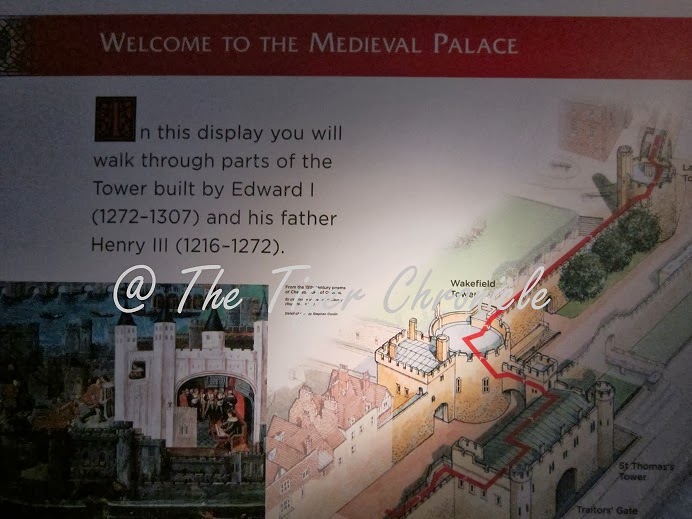
I remember that the Tower of London has a Medieval Palace with Edward I's bedchamber preserved there (although he hardly ever used it, considering that he mostly lived in encampments due to his numerous campaigns), so off we went.


Since the focus of our visit was on Edward I, we headed straight to the Medieval Palace.


There is not much to see of Edward I's bedchamber apart from the space it was supposedly located, as well as a few original timber frame and wall plastering.


Since Edward I was always out and about, I don't suppose he had much use for his bedchamber at the Tower anyway.  Nonetheless, it was good to have had a look at it:


The rest of the Medieval Palace has been well preserved, with much information about the medieval kings and courtly life dotted around.


The small chapel in the Medieval Palace was particularly interesting as it has marks a spot in front of the altar where Henry VI allegedly died.


Before we left, Tiger made a medieval knight's helmet out of paper to mark our visit.


The Tower is so steeped in history that I am quite sure we shall be back for future visits.


This post is linked up to:
  1. Look What We Did 
  2. Hip Homeschool Hop - 10/15/2013
  3. History and Geography Meme #95
  4. Collage Friday: Exciting News about a Great Journey
  5. Entertaining and Educational - Oct 18
  6. TGIF Linky Party #99
  7. Homeschool Review and Resource Link-Up
  8. Weekly Wrap-up: The One in Which I Felt Super Productive
Related Posts Plugin for WordPress, Blogger...