Showing posts with label math-addition. Show all posts

Wednesday, 2 April 2014

Maths as a Pleasurable and Sociable Pursuit

Can maths ever be a pleasurable and sociable pursuit for a normal young child?  The answer appears to be a positive "yes".

To start with, maths is done slightly unconventionally in our house.  Instead of following a specific curriculum, we tend to work on a certain topic that interest us at any given moment.  As it turns out, we have been spending a fair bit of time on simple arithmetic in the past few months, as I said we would.

The independent aspect of maths learning here takes place when Tiger reads maths-related books on his own, such as the ones pictured below:


He enjoys reading them repeatedly but he doesn't want me to get involved with his reading.  When I saw what can be done with these books, I offered to work through the problems with him but my offer was politely turned down.  Somehow, despite (or maybe, because of) very little involvement on my part, Tiger has found his own pleasure in maths and an inner confidence to put the following notice up outside his room:

Note the happy face on his selfie.

Since he became the self-appointed 'consultant maths guy' in the house, Tiger has been pestering me for "worthy" maths problems.  Sometimes I show him maths puzzles from this book, which he attempts to solve on his own before working collaboratively with me to find different solutions.


At other times, he sets himself the target of working through the problems/puzzles in the following book:


Once again, he doesn't want me to get involved in his work here.   The reason he gives is that he can check the answers at the back of the book, and since the solutions are also provided, he can figure them out by himself.  Fair enough.  Nevertheless, Tiger is happy to share his approach:  he raced through the "Easy" section within an hour and is a quarter of his way into the "Hard" section.  There are some concepts in the "Hard" section that he hasn't come across yet, which he wants to figure them out by himself so he is working on one problem a week -- he reads the question on Monday, thinks it through for the rest of the week, then solves the question on Friday.  When asked why he needs a whole week for one question, his reply is that he wants to "think through all possibilities and get it right" (his words).


Tiger will not have engaged himself in the above activities if he didn't derive some pleasure from solving mathematical problems, mostly on his own but sometimes collaboratively with me.  Recently he has progressed to sharing his mathematical discoveries (mostly applications of numerical patterns) with Tortoise and I by giving us mini lectures in the evenings.  Again, to give lectures as a way of showing what he has learnt is entirely his own idea; Tortoise and I are usually given a few hours' notice to attend a lecture in the evening.  It suits us fine since we are keen to know whether and what Tiger is capable of learning on his own.
When learning to learn is given a higher value than the learning of information, then the educational system will have made a big step in the direction of enabling children to be autonomous students (in the general sense) for life.  By encouraging the exploratory aspects of learning, its excitement and inherent satisfaction can be generalized into an approach to all life experiences; learning then is not associated only with school and the classroom, but becomes a part of living.
-- Joan Freeman, Gifted Children, page 272

Tiger's maths lectures so far have been very interactive and engaging.  He usually starts off with an example of how he applies his method to a problem, then he explains how he arrives at his method, which is followed by a very lively Q&A session where he is often challenged to defend his new-found techniques.   He is thrilled when his discoveries withstand the grueling challenges thrown at them from the floor, yet he is also able to find the grace and courtesy to accept that a few of his conclusions have been wrong due to careless calculation mistakes or a logical oversight.
Gifted children can jump to conclusions by a process of brilliant mental leaps, which are wrong because of lack of information.  In a reassuring 'safe' exploratory classroom, mistakes are part of the process of learning; they are not 'failures'.
-- Joan Freeman, Gifted Children, page 273


I find it interesting to observe that Tiger appears to be more receptive to learning maths in this way rather than in the traditional instructional way.  To my mind, the traditional way is a very quick way to learn something -- someone tells you the 'right' way to do things and you just practise until you master it.  However, that's not how Tiger likes to learn, at least where maths is concerned.  His preference for learning through discovery takes a lot longer, and can sometimes lead him down the wrong path where he has to back track and relearn some of what he thought he knew, but he won't have it any other way.  Luckily for him, being homeschooled gives him the time, space, and support to do just that.  Can you imagine how his approach to learning would be interpreted in the mainstream schools?  "Unteachable" is a word that comes to mind, but that applies only if the teacher has very fixed ideas about what teaching and learning look like.  A child like Tiger may appear to resist formal instructions, but that doesn't mean he lacks the ambition, enthusiasm or capability to master his chosen subject matter.  The challenge, then, is for the adult to get to know the child so well as to be able to provide the right kind of support at the appropriate level.
The teacher of the gifted child is in a particularly important position - not there to demonstrate her superior knowledge or to show what a good actress she is, but to enable children to grope and leap towards understanding.  It is important that the bounds of that understanding are determined by the characteristics of the pupils, not of the teacher or the school.
-- Joan Freeman, Gifted Children, page 273

Besides the in-house lectures, the more obvious social aspect of Tiger's mathematical pursuit comes in the form of maths circle.


We don't attend these very often due to their infrequency, but we enjoy them immensely every time we go.  The maths circle informs us of a number of things:
  • that mathematicians work both alone and collaboratively with others to solve problems;
  • that real maths problems are multi-dimensional and require an ability to connect various topics that are currently taught in segregation;
  • that it's fine to spend a long time on a single problem;
  • that sometimes the solution doesn't come even after a long time of thinking.

At the latest maths circle, Tiger spent the entire time there trying to solve one maths problem, and that was with the help of two maths undergraduate students.  I watched from a safe distance (far enough not to interfere) as the three of them racked their brains for nearly two hours, trying to grapple with that problem using various hypotheses, numerous discussions, and multiple experimentations.  Although he did not solve the problem by the end of that session, Tiger came away feeling exhilarated and asked to attend more of such events.

Between this and a method that produces children who "can't wait to be done with boring maths", I'd be happier to take the former even though it looks nothing like the time-honoured (although not necessarily successful), conventional way of teaching and learning maths.

The following documentary addresses directly the American public, but the issues discussed are just as applicable to the UK and indeed, to anywhere in the world that subscribes to the "standards" of mass schooling:


This post is linked up to:
  1. Hip Homeschool Hop - 4/1/14
  2. Entertaining and Educational - West Africa Study
  3. Collage Friday: Como Se Dice?  Dad's in Honduras
  4. Weekly Wrap-Up: The One In Which Spring Sprang... or Is It Sprung?
  5. The Homeschool Mother's Journal (4/5/14)

Tuesday, 28 January 2014

Eye on the Ball, Please! Part 3

http://thetigerchronicle.blogspot.co.uk/search/label/series-term%20plan

This is the third part of a series of my termly plans.  The first two parts are:
  1. Ball #1: Language Arts
  2. Ball #2: Mandarin

Ball #3: Mathematics - Addition and Area
The way that we have been learning mathematics here seems to be increasingly topic- or themed-based rather than curriculum-based, which suits us fine.  We started off following a maths curriculum, which worked very well, but was starting to get a little tedious for Tiger.  Once we started experimenting with learning-what-we-want-to-learn-when-we-want-to in maths, the approach feels a lot more logical and natural to us and is what we do now.


This term we are going to focus on two topics:
  1. addition
  2. area

What About Gaps?
It seems that many homeschoolers are uncomfortable with the idea of not following a curriculum in maths.  Usually their biggest concern is gaps in their children's maths skills or knowledge.  Following an established curriculum certainly gives some people -- notably adult and children who are naturally predisposed to a systematic, highly organised way of learning -- a sense of security that they have "covered everything" that a child of a certain age/level needs to know.

The way that I handle the question of gaps is very simple:  I make a mental note of it when I notice it, then I find an opportune time to introduce it.  The next question then is, what is an opportune time?  Well, my definition of an opportune time is:
  • when I have gathered the necessary teaching materials/resources; or
  • when the topic ties in with another area that we are studying, e.g. there are many cross-curricula opportunities to be created around the topic of geometry, symmetry, tessallations, Islamic art, etc; or
  • immediately - we are prepared to drop everything else if it is a matter of urgency to learn a certain topic.  So far, we haven't come across any situation that requires us to adress our mathematical deficiencies immediately.

My confidence in our approach comes from the realisation that:
  1. Time is on our side.  Tiger is only nine years old so he still has quite a few years to go before he has to worry about standardised tests or entrance exams.  I might start panicking if we were still on the topic of addition when he is 19 years old.
  2. Tiger is capable of buckling down to do the work when it becomes necessary.

Once I got over my initial fear of gaps (yes, I experienced much doubts and fears in the early days as well), I have come to view the learning of mathematics to be more than the acquisition of multiple sets of facts, short-cuts, and formulae.  It is a language of its own.  As soon as I realised that mathematics is a language, I decided that, as with any language-learning, establishing a strong foundation is very important.  Just as a strong language user needs to have a contextual base to understanding and mastering the subtlties of any language, a strong maths user needs to have be able to apply mathematical skills and knowledge for them to become meaningful.  Merely memorising mathematical formulae without the experience of applying them to solve real problems (as opposed to clinically designed textbook problems) is akin to memorising English idioms without knowing how to use them in the right context.


What About Practice and Mastery?
Having explained (I hope) above why I'm ok with Tiger's maths progress not following exactly in the same order or at the same pace as determined by any curriculum, you can see why I can tolerate us dwelling on any topic -- addition comes to mind immediately -- forever.  However, the time that we spend on any one topic is not used on repetitive drills or learning the same set of skills at the same level over and over.  An example is the latest addition game that we played.   Different maths skills were used at the same time to solve that set of problems -- addition, long multiplication, counting, number sense.  When we play maths games or riddles like the example that I have just referred to, both Tiger and I can easily and clearly determine whether he has any gaps in his knowledge (in which case we will work at closing those) or where his gaps are (so that we can direct our effort more effectively)

A tool that I find to be effective for practice is the Khan Academy's maths section.  I've mentioned before our sporadic use of the website whenever we feel Tiger needs to have more focused practice on any topic.  Most recently, we discovered a new feature on the website called Mastery Challenge, which is very similar to a series of short composite tests on various maths topics.  Tiger doesn't mind working on a few rounds of these each day.


To me, it works in the same way as what we have been doing at home to identify gaps and areas of improvement. For example, one of the recent challenges shows that Tiger needs more work on the long division (which we had touched upon briefly in November but not formally worked on yet).  With this information, Tiger watched the two-digit division video:


and worked through the example alongside the video, before attempting several rounds of two-digit divisions on the site.  Working on these exercises enables Tiger to solve a recent maths challenge, but it is not the way in which I would like him to learn long division (even though he certainly can do them mechanically now), so we will spend some time later in the year to learn division in a more visual, hands-on way.


I don't claim that our method of learning maths is superior to any other method, but it is one that suits Tiger's need for variety, applicability, and minimal repetition.


Thursday, 9 January 2014

When Everything Adds Up

Now that we are very familiar with straightforward addition, let's try our hand at finding the sum of all the numbers in a range, say from 26 to 765, without using a spreadsheet or calculator?

In order to learn the technique to work out sums of the above nature, let's start with the basics.

Q1: Find the sum of all whole numbers from 1 to 10.
The answer (55) can be easily worked out mentally or by writing the sums out on a piece of paper, but we are trying to learn a logic that will enable us to work out sums of any range.

To do this, I used a piece of cotton string and attached each individual number card 1 to 10 with paper clips.


I then asked Tiger what he would do, besides using mental calculation, to find the sum of all the numbers from 1 to 10.  He removed all the numbers from the number line, so that all ten numbers were accounted for, and paired them up into equations with the same sum total of 11 each:

            1 + 10 = 11
          2 +  9  = 11
          3 +  8  = 11
          4 +  7  = 11
          5 + 6   = 11


Once Tiger set the five equations out on the floor, it was obvious that the sum total would be 5 x 11 = 55, which tallied with his mental calculation.

I then reset the number line with numbers 1 to 10 again, and asked Tiger whether he could solve the problem in a slightly different way, i.e. using a total that is not 11.  When Tiger couldn't think of any other way after a while, I suggested changing the total to 10.  This way, the logic behind the solution is the same as before, except that there are a few extra steps:

When we set the total to be ten, the number 10 is removed first from the number line.  That is followed by the pairing up of numbers that make up ten.  When the pairing is completed, you will find that the number 5 is left unpaired.


The pattern will look like this:
                  10 
          1 + 9 = 10
          2 + 8  = 10
          3 + 7  = 10
          4 + 6  = 10
                5

Therefore, the final summation to find the answer is:
           (5 x 10) + 5 = 55

Between the two methods (sum to 11 versus sum to 10), I personally lean towards the one with sum to 10, but Tiger prefers what he considers to be the more straightforward method of summation to 11.  As you've seen from the above, both are equally valid so the choice depends on what makes the most sense to the child.


Q2: Find the sum of all whole numbers from 12 to 30.
We tried another exercise to check whether Tiger has understood the logic/technique to apply it to another question.


Tiger had a choice of using whatever method that worked best for him.  He chose to do the first method, i.e. the one where the first number (12) was added to the last number (30), and so on.


By doing so, he found that he had the 'middle number' (21) left unpaired, so he put it at the top of his layout so to ensure that he did not forget to add it to the final answer later on.


The pattern that he found was this:
                   21
          12 + 30 = 42
          13 + 29 = 42
          14 + 28 = 42
          15 + 27 = 42
          16 + 26 = 42
          17 + 25 = 42
          18 + 24 = 42
          19 + 23 = 42
          20 + 22 = 42

Therefore, the final summation to find the answer is:
           (9 x 42) + 21 = 399

At this point, I introduced another concept to Tiger: how to find the number of items (in this case, the number of pairing) from one number to another.

By counting or just looking quickly at the layout above, we determined that there were nine sets of pairings that summed up to 42.  Counting is fine until the range gets too large.  Therefore, I asked Tiger how he would determine the number of pairings without counting.  When he started to experience some difficulty, I asked him to think about how he would determine the number of pages he has read in a book, say from page 1 to 10.  After first he said the asnwer would be nine pages since 10 - 1 = 9, but when he quickly realised that the correct number was ten.  That was a bit puzzling.  I then asked him how many pages he would have read had he read from pages 2 to 11.  Again, answer is ten, but if he had applied the simple subtraction method of 11 - 2, he would get only nine.

By now, Tiger saw the logic behind this: that the number of items in a range is the simple subtraction of the last and first numbers followed by adding one more to it.  I helped him with the next step by putting his explanation into a simple formula:
        the number of items in a range = last number - first number + 1

We then verified our formula against the two examples above by first applying the numbers to the formula followed by verifying our answers with visual counting.


Q3: Find the sum of all whole numbers from 27 to 68.
Now it's time to see whether Tiger really knows what to do, so I set him the following exercise and left him to solve it himself:


Tiger proceeded with it methodically:
First, he laid out all the numbers in pairs so that every number on the number line was accounted for.  The sum of each equation was 95.  The pattern that he made was:
           27 + 68 = 95
          28 + 67 = 95
          29 + 66 = 95
          30 + 65 = 95
          31 + 64 = 95
          ......
          45 + 50 = 95
          46 + 49 = 95
          47 + 48 = 95


Using the formula he learned above, Tiger found out that there were 21 sets (48 - 68 + 1 = 21) of equations that each added to the sum of 95.  Therefore, the final answer was
      21 x 95 = 1995.


Once Tiger has got the hang of it, he is now able to find the sum of all whole numbers from different ranges.  I gave him a few extra questions to work on:

Q4: Find the sum of all whole numbers from 5 to 100.


Q5: Find the sum of all whole numbers from 36 to 205.


Q6: Find the sum of all whole numbers from 12 to 156.


Q7: Find the sum of all whole numbers from 4 to 237.


Having said all of the above, it makes sense to acknowledge that we are dealing with elementary maths, which is essentially concrete, so perhaps not...


Watching the clip above led us to ponder more with about the following:


If one gets into higher, more abstract maths (as the following videos show), then the concrete number sense that we have just spent so much time learning are nullified, similar to how conditions of quantum physics defy many common laws of physics.


But I'm not worried about that just yet.  I'm happy that Tiger is enjoying the concrete aspects of maths at the moment.


This post is linked up to:
  1. Entertaining and Educational - Atoms
  2. Collage Friday - No Spend Month, Marriage, Menus, & Miscellany
  3. Weekly Wrap Up: The One Where Dad Was Home
  4. The Homeschool Mother's Journal {January 11, 2014}
  5. Hip Homeschool Hop - 1/14/14
  6. Math Teachers at Play #70

Tuesday, 24 December 2013

Solutions to Maths Challenge

Did you have a chance to try out the maths problem posted about two weeks ago?  We have three different solutions for you.

I found one solution:  2 + 566 + 190 = 758.


The next two are Tiger's solutions:
1) 789 + 266 = 1055


2) 965 + 725 = 1680


Wishing everyone a very Merry Christmas and a Happy New Year!


I hope all of you have a restful time with your friends and family, and we shall see you back here in the new year refreshed and ready to go!

Tuesday, 17 December 2013

Finding the Balance

Algebra.  Sounds like a really sophisticated maths idea, doesn't it?  The truth is, most children already intuitively know the basics of algebra without calling it that.  The concept of single-variable algebra can be very simply introduced using the following tools:
  1. a balancing scale
  2. several one-pence coins (or the equivalent of the smallest monetary denomination in any currency)
  3. modeling clay of different colours

To prepare the materias, I first made a clay ball with the equivalent weight of a 1p coin.


I often like to get Tiger involved in making his own learning tools, so I got him to help me make the equivalent-weight clay balls.


That is, until it occured to me that I had to make the clay balls myself to make the game work, so I diverted his attention to a few slices of cake while I carried on with making the following clay balls:
  • orange clay balls ("O") - each is equivalent to the weight of one 1p coin
  • purple clay balls ("PB") - each is equivalent to the weight of two 1p coins
  • green clay balls ("GB") - each is equivalent to the weight of three 1p coins


Now we're ready to play.

The first step is to give the child an idea of balance, i.e. the one side should be the same as the other.  Without Tiger seeing, I placed five 1p coins in the right-side tray and covered it with a tissue paper.  Then I asked him to find the equivalent number of coins to balance the scale.  When he found the scale to balance with five 1p coins, I lifted the tissue paper to reveal the answer.


Next, I repeated the step above, but this time I used two orange clay balls and four 1p coins on the covered, right-side tray.  I then asked Tiger to find the number of 1p coins it would take to balance ths scale.  He found that it took seven 1p coins to balance the scale.


Tiger immediately knew then that each orange clay ball represents one 1p coin.  I asked him how he would represent the information on the scale as an equation.  This is his equation:

         7 "1p" = 5 "1p" + 2 "O"
==>    1 "O" = 1p


I did another exercise with him to make sure that he understood the concept.  This time I used three orange clay balls and three 1p coins, asking him to find the equivalent number of 1p coins to balance the scale.


After he has found it to be six 1p coins, I asked him to write the equation down again:

         6 "1p" = 3 "1p" + 3 "O"
==>    1 "O" = 1p


Just as Tiger was starting to think the game was too easy, I changed it slightly.  For the next go I used one purple clay ball and five 1p coins (covered up using tissue paper) in one tray, and asked Tiger to find the number of 1p coins to balance the scale.  He found it took seven 1p coins.

When I removed the tissue paper, Tiger was briefly stumped by the number of items on the right-side tray.  He quickly figured out that the purple ball must weight more than the orange balls that were used earlier.  He then went to to figure out that the purple ball must be equivalent to two 1p coins.  When asked for the equation for this, he said:

              7p = 5p + 1 "PB"
==>   1 "PB" = 2p


More variations on the same theme followed.  Next up, I used two green clay balls and five 1p coins.  It took eleven 1p coins to balance that. Using the same reasoning as the example above, Tiger worked out that each green ball is equivalent to 3p.  Obviously there have been some mental calculations that involved addition, subtraction, and division to arrive at the answer but Tiger doesn't like to write out all the intermediate steps.  Therefore the equation for this is shown as:

             11p = 5p + 2 "GB"
==>   1 "GB" = 3p


For the last exercise, I used two purple clay balls and three 1p coins, which Tiger found to need seven 1p coins to balance.


Once again, he worked out that each purple ball is equivalent to two 1p coins, equation as below: 

              7p = 3p + 2 "PB"
==>   1 "PB" = 2p


This time, Tiger wanted to show his 'proof' of how he arrived at his answer, so he demonstrated by removing three 1p coins from both trays, leaving four 1p coins in the left-side tray and the two purple balls on the right-side tray.  He did not write out the equation for this, so every step was done visually and orally.  For those who would like to see his demonstration in mathematical form, this is how it would look:

                  7p = 3p + 2 "PB"
==>     7p - 3p = 3p + 2 "PB" - 3p
==>             4p = 2 "PB"


From here, it is then a matter of applying simple division to find what each purple ball is.

                4p = 2 "PB"
==>     4p / 2 = 2 "PB" / 2
==>      1 "PB" = 2p


This post is linked up to:
  1. Hip Homeschool Hop - 12/17/2013
  2. Entertaining and Educational - Christmas
  3. Collage Friday - Remembering Ecuador
  4. Weekly Wrap Up: The One that will be Hard to Top for a While
  5. The Homeschool Mother's Journal {December 21, 2013}
  6. Math Teachers at Play #70 

Tuesday, 10 December 2013

Simple Elegance

I love maths that challenge us to think, but are deceptively easy at first glance so that they don't put children off.  This week, I gave Tiger one of these simple and elegant maths riddles that require a good understanding of:
  • mental calculation
  • addition
  • place value
  • numbers


The idea is to use the ten digit cards, as set out above, to lay out an addition equation visually in the vertical format.  A few rules to bear in mind:
  1. The digit zero (0) cannot be used on its own.
  2. The digit zero (0) cannot be placed in front of any number, i.e. it can't be used as "081" and such like.
  3. The addition sign (+) is assumed.
  4. The final number on the last line is the sum.
  5. No carry-overs are to be shown.
Easy, no?  For example, 76 + 80 = 156.  Each digit in the equation is selected from the set above.  The solution would be shown as follows on the table:

               76
            80
           156

Or, if the equation is 25 + 66 = 91, the solution would be presented as:

             25
             66
             91

All clear?  Ready to go?

The idea is to start with any combination using the set of ten cards as shown in the photo above, then slowly build up to using all ten cards.


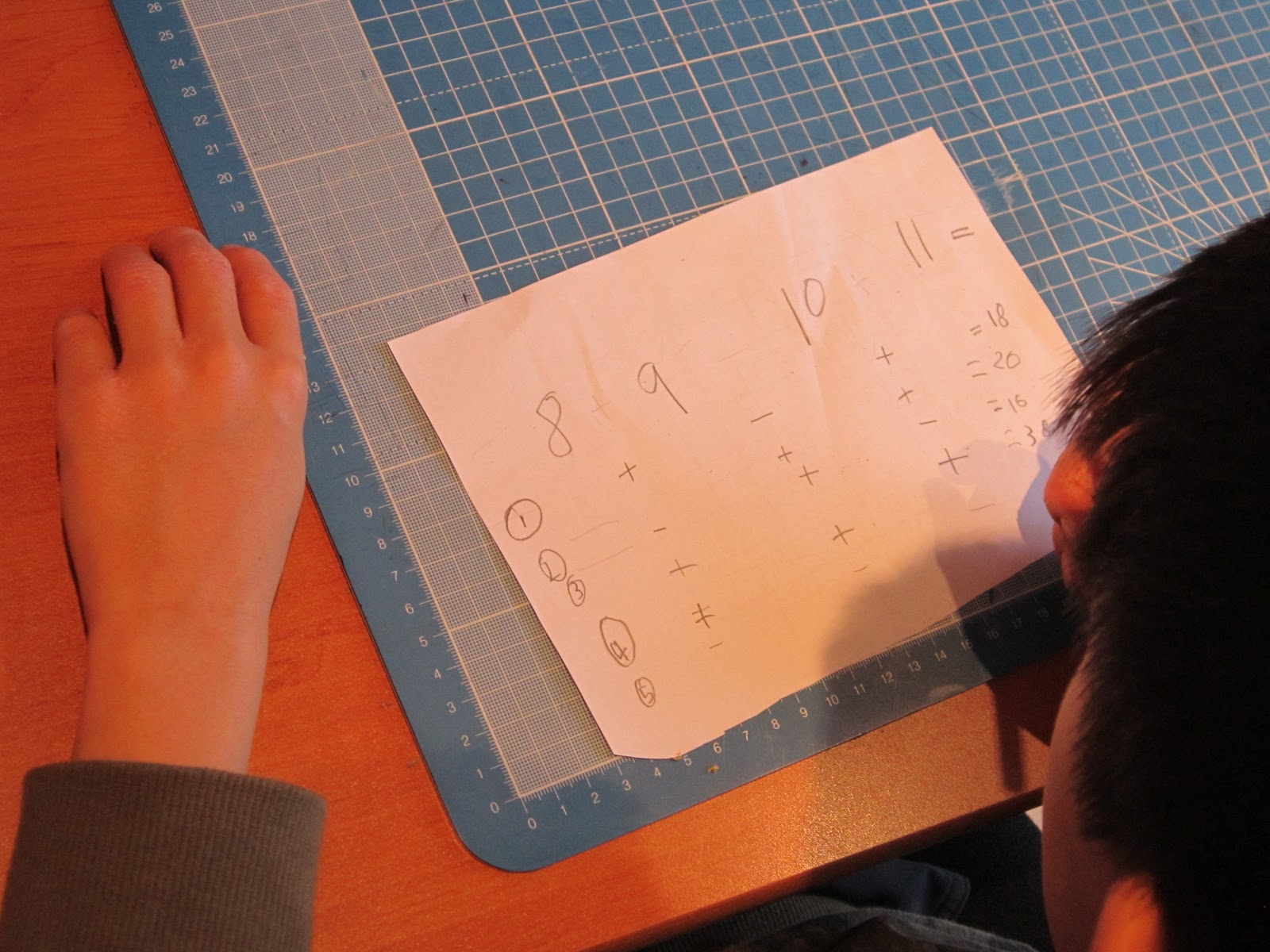
Tiger quickly found numerous solutions using three to nine cards, but he struggles to use all ten cards in a single solution.  The game is too much fun to just sit and watch so I used a second set to play alongside Tiger, at which point it turned into a competition between us to see who could find the solution to the ten-cards problem first.  I am pleased to report that I have uncovered one solution to the ten-cards problem, although it did take me quite a few attempts.  I'm sure there is more than one answer to this problem.  Tiger hasn't found his solution yet.  His challenge is to find the solution by Christmas eve, while mine is to find at least one more solution by then.

Join in the fun if you feel inclined!  I'll post our solution(s) on Christmas eve.


This post is linked up to:
  1. Hip Homeschool Hop - 12/10/2013
  2. Math Activity Thursday
  3. Entertaining and Educational: Travel is One of the Best Ways to Learn
  4. Collage Friday - A New Camera and Birthday Happenings
  5. Weekly Wrap Up: The One Where I'm Still Not an Aunt
  6. The Homeschool Mother's Journal {December 14, 2013}

Monday, 11 November 2013

It's Simple, Really

I decided that we should get back to the basics of maths -- addition -- with the following simple exercise.


I gave Tiger a copy of a sheet printed with ones, tens, and hundreds boards.  The total of which is 999.  His task was to split the sum into four addends.  Very easy, isn't it?  That was what Tiger thought.

Before Tiger began, we had a quick review to make sure he understood the different terms (addends, sum).  I also showed him a quick example of how he was to split the sum into four addends (example on the bottom left)


As you can see from the photo above, Tiger split the total of 999 into four addends immediately (the example on the bottom right)

The next task is to cut out the printed sheet and use the arrays to form the addend in each section on the construction paper.  This was where Tiger realised that he had to consider the limitation set by the arrays, i.e. 9 ones, 9 tens, 9 hundreds.  With this limitation, the initial answer he gave (251, 199, 151, 398) could not work.  This made him work a little harder than merely throwing random numbers out to make the sum total.

After some struggle and when Tiger started showing signs of frustration, I suggested that thinking about place values and the limitation set by the arrays and having to split the sum total into four addends at the same time might help.  The light came on when I sketched the array on paper (see pencil mark below):


Once he saw the sketches, Tiger understood how to approach the problem.  There are a few ways to solve the problem.  Below is Tiger's solution:


This post is linked up to:
  1. Hip Homeschool Hop - 11/12/2013
  2. Entertaining and Educational - Chinese Shadow Puppets
  3. Collage Friday - The Best Apple Cake and Frog Guts!
  4. Weekly Wrap Up: The One with A Lot of Cat Talk
  5. The Homeschool Mother's Journal {November 16, 2013}

Wednesday, 20 February 2013

Playing with numbers

Every now and then, Tiger and I get slightly bored by how maths is done at home and both of us want to make changes to how we do maths.  It seems that we have come to a point where I am comfortable with Tiger's grasp of the fundamental concepts in elementary maths that we can afford to be more adventurous in taking detours from our usual maths routine.

Rather than playing random maths games (nothing wrong with that), I am inclined to take a thematic route in this area.

We started with the topic of "numbers".  The first activity we did was to make a number chart puzzles.  This was intended to help cement the concept of consecutive whole numbers.

First I printed off a number chart of whole numbers from 1 to 100, and had Tiger block out different sections with coloured pencils (to be cut out later) to make the puzzle.


The first one with consecutive whole numbers was too easy, so we did another in multiples of 10.


That was just warm-up.  Next, we played all the games found on this page.  These games were fun refreshers for Tiger in the concepts of multiples and odd and even.  His favourite game was Read My Mind.


Tiger and I found more challenges and satisfaction at solving maths puzzles that require a combination of different skills, which involve mathematical thinking as well as visualisation skills.  The four puzzles we worked through together were:

1. Make 37 (main concept: odd and even numbers)

2. Mystery Matrix (main concept: multiplication)


3. Consecutive Numbers (main concept: addition and subtraction)


4. Magic Vs (main concept: odd and even numbers)


We love these maths games!  They tend towards the abstract side of mathematics, which helps if you have strong maths foundation and visualisation skills.  Manipulatives don't work so well to solve such puzzles.  Additionally, it is also a very involved process for parent and child in that we would discuss, debate, and argue about how we would approach the problem, before solving it together.  Discussion is a big part of the learning process for such puzzles (at least in our case), so I don't think these puzzles will be as effective without parental involvement.  We find the process to be very interesting and mutually beneficial in that Tiger can apply his intuitive problem-solving skills while I can observe and learn more about the way he thinks, which is very different from my thinking process.

Tiger can pretty much hold his own in our maths discussions now due to his strong intuitive and visualisation skills in solving maths problems, while I bring logic and methodology to the table.  So far, this has worked very well for us.

Another number game that Tiger has taken an interest in is Sudoku.  He takes the book with him and solves a few puzzle on the go each time we are out and about.


This post is linked up to:
1) All Year Round Blog Carnival: Winter 
2) Hearts for Home Blog Hop #5
3) Homeschool Mother's Journal: February 22, 2013
4) Hobbies and Handicrafts - Feb 22
5) Collage Friday - Family, History, and More
6) TGIF Linky Party #64
7) It's a Wrap
8) Weekly Wrap-Up: The One with the Busy Break Week
9) Share it Saturday - Feb 23
10) The Sunday Showcase - 2/23/13
11) Math Monday Blog Hop #88
12) Hip Homeschool Hop - 2/26/13
Related Posts Plugin for WordPress, Blogger...