Showing posts with label art-colour. Show all posts

Wednesday, 11 July 2012

Art class: Complementary colours part 2

Following from the previous week's introduction to complementary colours, this week the children learned the different effects of: (1) placing complementary colours side-by-side, and (2) mixing complementary colours together.


The first concept of simultaneous contrast was easily demonstrated by putting two complementary coloured pieces of paper (e.g. red and green) side by side.  The second concept (which causes dullness to one colour) was shown by mixing a little red into green.


Since the second concept of dullness did not appeal to the children very much, I had them do a cut-and-paste project to illustrate the first concept of simultaneous contrast that produced bright and colourful results.
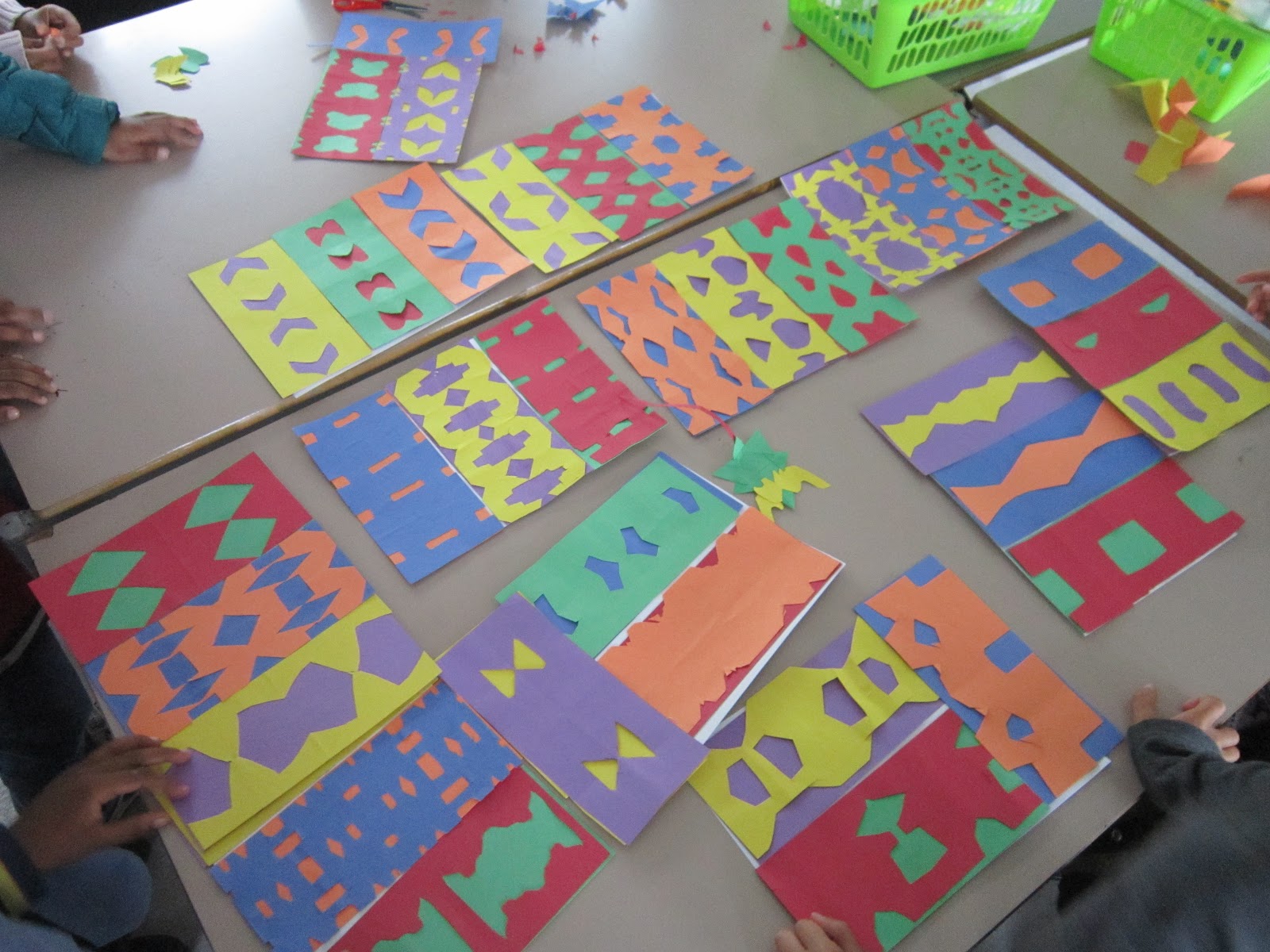

This class concludes our unit on colour.  I received favourable feedback from the mothers, which has certainly been very encouraging:

"Sharon* is very enthusiastic about your art classes, she has just asked me what we are going to do tomorrow, which medium, what to bring..."
-- Sara*

"I would like to convey our appreciation from myself and other mothers who are really impressed with your teaching.  Thank you so much. All the children really look forward to art. Your passion and deep interest and knowledge come across to them and you inspire them.  We are very fortunate to have you teaching the kids."
-- Zoe*

"Sarah* is most definitely enjoying the art classes...since starting your art class she is much more enthusiastic and will happily sit down independently to do something creative.... credit to you as their teacher as it shows the children are defintely taking in the theory side of things and it also shows the planning that has gone into these sessions as well as to how structured the lessons actually are...Thank you very much for your time, effort, hard work and patience with our children."
-- Alice*

"Great class. John* loved it and he was very proud of his pictures today.  Thanks so much!  He draws everyday now, eversince he started taking your class.  He wouldn't do any art previously because someone had told him that he drew like a baby."
-- Jenny*

* names have been changed to protect the privacy of the individuals.

While it has been a positive experience working with the children and introducing them to art, I am taking a short break for a few weeks to review whether to continue with the responsibility.  Teaching a whole class of children takes much planning with regards to lessons and materials, which inevitably means I have even less of the little bit of 'free time' left for my family and for myself.  Even though it has been wonderful to be able to serve others and to have received positive acknowledgement for my effort, it is also important to take care of the needs of my family and myself.


This post is linked up to several blog hops, where you can see what other homeschoolers have been busy with.

Thursday, 5 July 2012

Art class: Complementary colours part 1

Our study of colour is getting a little harder now, as we move into the area of complementary colours.  I started with a revision of the colour wheel of primary and secondary colours.  Having the colour wheel visible on the whiteboard was very useful in the class to help the children relate to what we were to study in the class in terms of complementary colours being opposites of each other.


Rather than have the children memorise the relationships between the colours, I let them experience the colour relationships for themselves by using coloured cellophane sheets.  I used the primary coloured sheets, one at a time, to let them see the respective complementary colours for themselves -- by first focusing their gaze on the middle of the paper, then seeing for themselves the afterimage when the paper was removed.  It was a wonder to see their faces lit up when they saw the 'magic' of the afterimage appearing.

Once the concept was understood, the children were set the task of drawing a picture in the opposite colours of what they would normally use.


This was a challenge for most of the girls in the class.  I do not fully understand the reason for their struggle, but my speculation is that perhaps the girls found it difficult to fill in colours that they perceived to the "wrong".  Regardless of their initial struggle, everyone in class eventually settled down to complete the exercise in earnest, producing vibrant and unique pieces of work.


This post is linked up to several blog hops, where you can see what other homeschoolers have been busy with.

Friday, 29 June 2012

Art class: Colour gradation

After last week's struggle with mixing colours using crayons, I decided to let the children try a variation of the exercise using temperat paint.  The first exercise was more structured in the sense that a template was given for the children to fill in, so that they get an idea of how the different primaries work together.


Then we tried out a still life painting that continued the exercise on colour gradation.  I place several ripening mangoes in the middle of the tables for the children to paint, all the while reminding them to apply their knowledge of colour gradation and mixing.


This post is linked up to several blog hops, where you can see what other homeschoolers have been busy with.

Friday, 22 June 2012

Art class: Colour wheels

A slight variation on colour mixing this week, with a bit of revision thrown in.  I wanted the children to see for themselves the effects of colour mixing using a dry medium (crayons) so that they would not think only wet medium is capable of being mixed, so I gave them a simple colour wheel to fill in.


After learning about the Primary and Secondary colours, the children now learned about Intermediary colours.  I explained that, in simple terms, intermediary colours are just different shades of secondary colours that are created by uneven proportions of two primary colours.


The children then got on with their exercise.  Admittedly, trying to create the different shades is very difficult to do with crayons, but the children did the exercise in good stride.


This post is linked up to several blog hops, where you can see what other homeschoolers have been busy with.

Friday, 15 June 2012

Art Class: Colour mixing

In this class I introduced the first element, Colour.  I talked to the children about the Primary colours and how they can be mixed to make the Secondary colours.  This was followed by a demonstration on paper of how colour mixing is done.


Then the children had a go at this exercise as well, using a limited palette of red, yellow, and blue.


The second half of the class was a little improvisation exercise based on the same colour-mixing theme.  I asked the children to fold their paper in half, paint on one-half, fold and rub their paint to create a symmetrical design.  When the paint has dried, they could cut them into interesting shapes.  I did a quick demo using a butterfly shape, and some of the children decided that they wanted the same.


This post is linked up to several blog hops, where you can see what other homeschoolers have been busy with.

Friday, 8 June 2012

Art class: Watercolour painting

I introduced watercolour painting to the children this week.  Most of the children in class would have had some kind of exposure to painting, but not necessarily with watercolour paints.  Before I let the children loose with the paint sets, I showed them: (1) the different types of brushes, and (2) how to take care of their brushes by demonstrating a sensible way to clean and dry their brushes.

After they have practised that for a few times, I showed the children the different ways of mark-making using a single, mid-sized synthetic brush, as well as different ways to create a wash, which also introduces them to the idea of colour mixing.


The children enjoyed creating their pieces and experimenting with the different ways of using their brushes and paints.


For some of the children in the class, this was the first time they have worked with watercolour.  The spontaneity and exuberance of their art work can be seen in the samples below:


This post is linked up to several blog hops, where you can see what other homeschoolers have been busy with.
Related Posts Plugin for WordPress, Blogger...