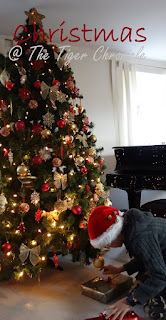
However, even though we are not reading A Christmas Carol this year, we find ourselves not being able to get away from it totally. As a result of Tiger being ill with fever most of last week, we found ourselves having a lot of time on our hands that we could spend on video watching. To my surprise, Tiger watched the 1999 movie version without his usual complaint that most movie versions are poor substitutes for the original storybooks. There have been numerous movie adaptations of the story, but the 1999 version is the one that stayed most true to the original, and it helps that Patrick Stewart (who played Scrooge) is a most excellent actor.
After we watched the movie, we thought we might as well review our knowledge about the origins of the story:
What I find interesting about reading/reviewing the same story each year is that not only does the story become part of our family's tradition at Christmas time, but my own understanding of the story grows with each reading. This sense of getting to know a story at a deeper level with each passing year comes with no surprise. What is perhaps surprising is how easily recognisable many universal human values, such as compassion and redemption, are in this very traditional, English story. Then again, isn't that what every good classic story is supposed to do?
Another reason for us not being able to completely ignore A Christmas Carol this year is that it is currently being discussed in the BerkerleyX Book Club, which is another free MOOC offered by edX. Tiger and I looked at the first week's coursework, which we felt has helped us consider a few points that we had not discussed in our previous readings.
Having spent a fair bit of time immersing in the world of the Victorian poor through Charles Dickens' novels, it was time to visit Dickens' adult home in London, which is now the Charles Dickens Museum.
The inside of the house is very much preserved in the same condition as when Charles Dickens was living there.
Of all the rooms in the house, I found the kitchen to be the most interesting place, which probably has muchg to do with my having to spend most of my time at home in the kitchen! Another eye-opening experience for us was seeing the wash basin in the laundry room that was used to keep the Christmas pudding (as was the practice in the Victorian times).
Two other items in the house also caught our eyes. The first was part of the Marshalsea prison grille, which represented a very traumatic time in Dickens' childhood. The actual prison is long gone (as we saw on the Dickens tour a few weeks ago) but bits and pieces of it still remains in various locations, and the prison is vividly described in a number of novels, most notably in David Copperfield and Little Dorrit.
The second is a simple-looking window that was mentioned in Oliver Twist as being the window out of which Oliver Twist was pushed by Bill Sikes during the burglary.
The window is very small, so one can imagine how scrawny and malnourished the poor boy must have been to be able to squeeze through it!
One of the most famous Charles Dickens character is Oliver Twist. The novel has been adapted so many times that everyone would have heard of it even if they had not actually read the book.
I find the novel difficult to read, less so due to Dickens' language but more because of his depiction of the cruelty operating within the Victorian workhouse system and the predatory nature of human beings upon those who are weak and vulnerable.
Using the same approach as we have done for our Dickens' study so far, we went out in search of the actual workshop that inspired the story of Oliver Twist. We found it in the abandoned annex (previously the outpatient unit) of the old Middlesex Hospital.
According to a book that has researched into the same topic, this part of the hospital was originally the Cleveland Street Workhouse in the Victorian times and was very nearly demolished had it not been for the campaigning efforts of people to preserve it for its link to the world famous novel. The building has been boarded up for years without any signs of conservation or redevelopment, so we could only peer through the narrow slits between the boards to look at the outside of the buildings.
The evidence of the close link to this particular workhouse -- for there were a number of workhouses littered in various parts of London -- is that Charles Dickens lived nine doors away and would surely have seen and heard of whatever went on inside and outside of it.
Not satisfied with being shut out of the workhouse, we went to The Geffrye Museum, which used to an infirmary for the elderly poor in east London.
We were there to find out more about the homeless in Victorian times (which inevitably meant admittance to a workhouse at some point under those circumstances).
As expected, it is not a particularly cheerful exhibition but it certainly gave us a very good idea of the plight of homeless people in the Victorian times, the various circumstances that gave rise to their dire fate, and of course, details and artefacts of the inevitable workhouse system.
We have read about and heard of inmates picking oakum in Victorian workhouses and prisons, so Tiger had a go at doing that inside the exhibition. He only did it for two minutes, yet that was enough to set him off, "This is stupid and pointless!" Having never set foot in an institutionalised classroom before, Tiger has no concept of people being given meaningless tasks to numb their minds or to punish them for falling on hard times.
The heartbreaking realisation that we have made is that there are currently 3.5 million children living in poverty in the UK. It is quite inconceivable in a modern day and when one walks about on London's main streets, but it is true. The difference between poverty in the Victorian times and today is that poverty seems to be 'invisible' today, as in, we don't see beggars and homeless people on the streets but they do exist.
Tiger and I went on a Dickens tour in London to help us trace the steps of some of the significant sights mentioned in his various novels. As Dickens' novels are mostly about lives of disadvantaged (and often poor) class in the Victorian times, the tour started, unsurprisingly, at Borough tube station.
Naturally, the tube station did not exist in the Victorian times, so what we are interested in is the layout of the road junction directly opposite the station. According to our tour guide, that layout has not changed since Dickens' time, except that it was used by horses and carts back then.
A few mintues' walk away is the St. George the Martyr church which features quite strongly in the novel, Little Dorrit, for it is the church where the named character was baptised.
At the north side of the church, less than 100 yards away, is the remains of the Marshalsea Prison where Charles Dickens' father was imprisoned for debts and where the fictional character of Little Dorrit was born.
The Victorian insolvency law, prior to the Debtors Act in 1869, is rather peculiar in that the people who could not repay their debts could be thrown into the debtors' prison for a very long time, and without any means of 'bailing' themselves out as they were not allowed to earn an income to repay their debts. Charles Dickens' family lived in the prison with his father for the duration of his imprisonment because they could not afford to live outside on their own, Charles being only 12 years old at the time of his father's imprisonment. The experience of having to live in a prison (albeit for a short period of time) and the consequential work experience at the blacking factory must have traumatised him greatly because the debtors' prison feature quite prominently in many of his novels.
Further along we came to a garden established by the Victorian social reformer, Octavia Hill. She was one of the pioneers who campaigned for better living conditions -- specifically open spaces in London -- for the poor.
A few streets along, we came upon an informal shrine for what is left of the Cross Bones graveyard. The site was basically a mass grave for the outcasts of society (most medieval to the Victorian time), i.e. the paupers, but mostly prostitutes.
After learning about all the sorrow and sadness (it appears that one needs to have quite a strong heart to be able to get through the real stories that inspire Dickens' novels), it was time to head to the inn. Not just any inn, but The George Inn, which has existed since the 16th century abd where both Shakespeare and Dickens had visited. It is also mentioned in Little Dorrit.
The fascinating thing about London is that it is such an old, historic city that there are significant sights of historical and literary interests to be found at nearly even turn. For example, what appears to be an ordinary, insignificant-looking alleyway turns out to be the site of the "White Hart Inn" mentioned in Shakespeare's play, Henry VI, and in Dickens' The Pickwick Papers.
On another day, we were walking in another part of London when we chanced upon The Old Curiosity Shop!
It is entirely possible that, as we are currently focused on Charles Dickens and his work, that we seek out opportunities to learn more about him, which in turn results in various serendipitous occurrences such as the above. One can certainly learn a lot by walking around in the ordinary parts of London -- in the same way that Charles Dickens did to gather ideas for his stories -- if the walks are taken with keen interest and a sense of curiosity about one's surrounding.
After spending two Christmases of reading A Christmas Carol by Charles Dickens, we finally have arrived at the Victorian period in our history study to justify spending more time learning about the man and his novels that serve as very strong social commentaries of what life was like in the Victorian times for the poor.
One of the Museum of London's workshops, Dickens in context, serves as the perfect tool for us to combine the study of both history and literature in the same session.
The workshop started with a drama session where 'Charles Dickens' was in one of his press conferences, with the children participating as reporters who asked him questions (prepared by the museum beforehand) that were designed to weave together his life story, the novels that he had written, and the Victorian society in general.
The session was cleverly designed to engage the children, so that everyone could get a really good idea of the context of Dickens' novels and characters even if they have not read all his work. Another point of interest is that we met Lucinda and her daughter at the workshop, who are both as lovely in person as they are on her blog.
The group then had a good hour to explore the People's City gallery, which showcase many artefacts that trace the rapid economic and social changes that took place in London from the Victorian times to the beginning of the Second World War.
The rest of the day was spent in an object-handling session where the group was shown real Victorian objects that they were to guess/identify the items and what they were used for, as well as the socio-economic class that those objects would have belonged to. The class divide was very pronounced in the Victorian times -- people today are still as obsessed about it although most have learnt to be more discreet -- so it was not difficult to figure out that the chimney broom and the shoe-shine box belonged to the working class while the hand mirror and the jewelry box belonged to the mid-to-upper middle class.
All the work done by the group that morning, i.e. the drama session, gallery viewing, object handling, culminated in a final, creative writing session where the children were given a short excerpt of one of Dickens' novels (each group had a different excerpt) and a visual representation of a Victorian scene (again, each group had a different picture), and they had to do a simple analysis of his literary techniques before attempting to write their own version of a descriptive paragraph in the Dickensian style in 10 minutes.
The group was of mixed ages (the children were 10 to 14 years old) and mixed abilities (some children are natural writers, while one or two struggle with putting words on paper), as is typical of homeschooling groups, so this final exercise was quite challenging for a few in the room but everyone attempted it in good spirits and was happy to share their individual writing with one another at the end. I was very impressed with the positive attitude of everyone in the room, and even more with the quality of the paragraphs each one wrote in the short time.
This week has been a "non-week", as in, there is nothing exciting or of interest to report. Tiger has been trying hard to get over his third-time-in-two-weeks cold, so we have been staying indoors and enjoying -- as much as we can muster our good cheer for -- the November weather:
There's nothing quite like a dismal, rainy November week to bring home the reality of my utterly unglamourous life and to spur me on to some form of escapism by looking ahead to December, which signifies (for me, personally) the start of the Christmas season which never fails to bring forth a warm, cozy feeling filled with images of glittering, bright lights.
I don't usually start thinking about Christmas until December 1st, but this week, because it has been so dull, I have taken the liberty to get started on my December/Christmas planning. I hope to be have a better idea of what we'll be doing in December, and to be able to share our plan in two weeks' time.
We were introduced to Dickens last December while reading The Christmas Carol. This year I plan to continue to explore The Christmas Carol more in depth (starting from Decmeber 1st), as well as Dickens' other Christmas tales. We are currently reading The Chimes from the following collection:
I am currently enjoying this little book which gives a good oveview of the Christmas tradition in the context of the larger scope of British history and traditions. Having married into an English family, I figured it is only basic courtesy that I should learn a little more about my husband's cultural heritage.
With the exam out of the way, Tiger and I started to look for recipes to make foodie gifts for people. We haven't set out to do it this way, but this year our Christmas theme seems to be "simple", especially if we were to compare it with our efforts last year.
It is so easy to make that we made two batches of them to give to everyone.
Next, Tiger made cards to accompany the foodie gifts. Again, this year's cards are very straightforward to make.
The material list:
foam Christmas tree template
green and red ink pads
alphabet stamps
strong craft cards
Christmas-theme craft papers
sequins
glue and scissors
To make the card:
Choose a Christmas-theme craft paper and trace the tree template.
Cut of the tree shape.
Paste it on the front of the card. Decorate the card with sequins.
Stamp the words "Merry Christmas" inside the card using the alphabet stamps. Tiger alternated the red and green inks for his words.
Once we've made our gifts, it was time to socialise with friends again.
I spent a day at a drawing workshop with my artist friends. Tiger tagged along and did a few drawings as well, but mostly he was enjoying himself by being a social butterfly during break times.
Tiger knew about half the people there, but by the end of the class he has made friends with everyone in the workshop, engaging each person or a small group in turn with various topics. I sat in a corner of the studio and talked with my own friends but all the while keeping half an eye on Tiger as he exercised his socialising prowess around the room. Some of the topics that I managed to overhear him talk to the adults about were:
the two world wars
making paper aeroplanes
military blunders
drawing, art, collage, Matisse
homeschooling, what he is learning at home
At the end of the workshop, a few people whom we met for the first time there came up to me to tell me how delighted they were to meet Tiger and how impressed they have been by his overall demeanour. I thanked them for their kind words, and was pleased that Tiger has contributed to some positive P.R. towards the overall impression people have of home-educated children. A few people there had never met a homeschooled child before. Now that they have met and talked with one in real life, I hope they will be able to rely on this experience and apply their critical thinking ability (assuming it is still intact) to avoid being duped into believing the ridiculous myths about homeschooling children.
There is certainly no shortage of opportunities to socialise this week!
We topped our reading ofA Christmas Carol by spending a day at a homeschool creative writing/book club. The book club is led by a homeschooling mum-of-six who used to be an English teacher. The format of the club is such that the children spend the morning discussing the book as a group, noting several points of interests, such as the author's writing style, or use of descriptive techniques. This is followed by a short creative writing exercise where the children will work in groups of two to five to get their drafts in before lunch.
Lunch there is a highly sociable, community event. Each mum brings a dish to share at lunch so food is always plentiful and delicious. This week being our last meeting before Christmas, lunch is especially scrumptious and in abundance, which is a truly wonderful way to enjoy the festivity. The children usually wolf down their lunch and run outside to play for an hour or so while the adults stay indoors to tidy up and chat.
In the afternoon, the children present their work to the group. Previous presentations include an adaptation of a novel into a play, a short paragraph written in the style of an author, and descriptive writing. On this occasion, the children were tasked with writing their own Christmas carol based on the structure and storyline of Dicken's story. I have been constantly impressed by the children's creativity and by the quality of their work, individual ones as well as group projects. Above all, I am grateful for the opportunity to be in the company of these parents who are contributing so much to creating the most suitable educational environment for their children.
I am going against the grain this year: I am NOT planning any specific activities this December. It has been liberating and eye-opening for me to see how and how much unscheduled learning happens when we just 'go with the flow'.
2. Mothers Who Embody Courage and Determination
Tiger has been attending a weekly hands-on science class since September. The class is held in a small church hall so the mums always sit at the back of the class quietly until the lesson is over, unless they are helping their children with a particular tricky part of the experiments. As such, there is very little chance each week for the mums to get to know one another beyond recognising one another's faces.
The sessions for this year have ended so one of the mums has kindly invited everyone to her house for a social gathering. It was at this gathering that I felt I have gotten to know these ladies much better, and I am very glad for that.
For example, I had no idea that one mother has managed to guide her son from being diagnosed as fully autistic (i.e. no speech, no eye contact, mentally delayed) at age two to being mildly socially awkward at age 14. This boy is currently preparing for GCSEs in biology, physics and chemistry. After listening to her amazing experience, I felt a profound sense of respect for this woman. Behind her meek, quiet appearance is a spirit of steel and courage.
It was only in the relaxed environment of the gathering that I got to know that the majority of the mothers here are single parents bringing up children on their own with little financial help from their ex-partners. Most of them are also having to cope with children who have special needs, e.g. diabetic, Aspergers, dyslexic. I don't know the ins and outs of how these mothers find themselves in their situation of becoming a lone parent, but I listened with respect and admiration to every story of the battles they have had to fight to get the support their children need -- financially, educationally, and medically.
Since Tiger has never been to school, I thought he would not share this childhood experience with the 95% of children his age who go to school. Although it is not a big deal to us whether he takes part in a Nativity play, I sometimes wonder whether he might have liked, when he becomes an adult, to be able to say something like, "Yes, I have fond memories of being the donkey lying in the manger in my Year One Nativity play." Well, you never know, do you?
Thanks to a new set of homeschooling friends that we've made this year, we were invited to take part in a Nativity play -- well, it's Tiger who has the part of a shepherd/narrator. My job is to take him to the premise, be part of a supportive audience, and socialise with everyone.
We had a group of 15 children, aged two to 12. The children memorised their lines beautifully from a script written by one of the very talented mums. The play was interspersed with Christmas carols played by a few children in their various instruments (trumpet, flute, recorder, oboe).
Waiting for their turns during the full-dress rehearsal.
Despite only meeting a few hours before the actual performance, the children were ready for the actual performance after three rehersals. The children's level of concentration and dedication to this project, their ability to work together, and the older children's ability and willingness to look out for the younger ones during the 25-minute production really shone through. What a fantastic group of children! I feel very privileged to have witnessed all the goodness in these children with my own eyes.
4. A Victorian Christmas
We are about half way through reading and listening to A Christmas Carol.
There are usually many Victorian Christmas activities available in various parts of the country around this time, and since the era ties in with the book that we are reading, we went to one to experience the jovial atmosphere of a Victorian Christmas.
There were diplays of Victorian toys, Victorian games, street musicians, street performers, and Victorian crafts. We found the hand-turned busker organ to be absolutely fascinating:
The event being of a Victorian theme in December, there was also a two-person street performance of A Christmas Carol:
As it was a two-person production team, they had to adapt much of the story and summarise it into a 20-minute play. Tiger enjoyed watching the performance in spite of its obvious adaptations. It's interesting for me to see him respond differently to adaptions made at a live performance than those made for films. I'd be curious to see his response to a film version of the story, when we watch it at some point.
5. A Bedtime Lecture
Tiger
is a very animated child and his bedtime routine has always taken
forever because he always has a lot to say when he is in bed. After
I've read him stories and kissed him goodnight, he always has something
he's excited about to tell me. It may well be his delaying tactic, but I
feel obliged to stay for an extra 15 minutes because he does often have
genuinely interesting things to tell me just before bed.
This week's bedtime topic of interest is computer networks.
Mum: (kissed him on the forehead and about to switch the lights off) Goodnight, darling. Tiger:Mum, do you want to know about computer networks? Mum: (hesitatingly) Umm... I don't know. Do I? Tiger: Yeah, they're very interesting. I'll show you a few diagrammes quickly and you'll understand them in no time. Mum: Well, ok.
That was his cue to sit up in bed in his dressing gown and start explaining to me how different networks work.
In
the 30-minute session, Tiger educated me about the different switches,
routers, how LANs (local area networks) and WANs (wide area
networks) can be designed and how they work, as well as how they can be combined in various ways to make
efficient cross-border networks. The mini lecture was delivered with
numerous hand drawn diagrammes to illustrate his examples:
I
vaguely remember studying two IT-related modules at university, so
Tiger's diagrammes and explanations made some sense to me. What I
enjoyed most in the session was his enthusiasm to share what he has
learnt so far.
Much to my own surprise, despite my non-plan it has been a very busy week filled with rich experiences to nourish our hearts and minds. I wonder what is in store for us next week.