Wednesday, 21 March 2012

He's still alive!

For the first time in our Artist Study we learned about someone who is still alive and well -- David Hockney.  To me, Hockney is a very interesting artist, in the sense that people either love his work or hate them; there is no in-between.  I went to see his current exhibition at the Royal Academy of Arts, which sparked my interest to introduce him to Tiger.

Introduction
With Hockney being hailed as "Britain's Greatest Living Artist", I have been surprised that I could not find any book in the library with a generic introduction and/or biography about him that is made accessible to young children.  Hence, I used the information found on BBC-Your Paintings as an introduction, as well as the clips found here.

Since I had bought a few postcards and materials from my own visit to the exhibition, I used these as well, just to give Tiger a sense of the variety of genres that Hockney has worked in and to prepare him for the visit to the Royal Academy where he would see the scale of the actual work for himself.

Field Trip
We are fond of the Royal Academy of Arts.  All the staff here whom we have come into contact with so far have been very helpful and friendly, so it is not hard for us to be persuaded to attend another one of their family workshop tied specifically to the Hockney exhibition.

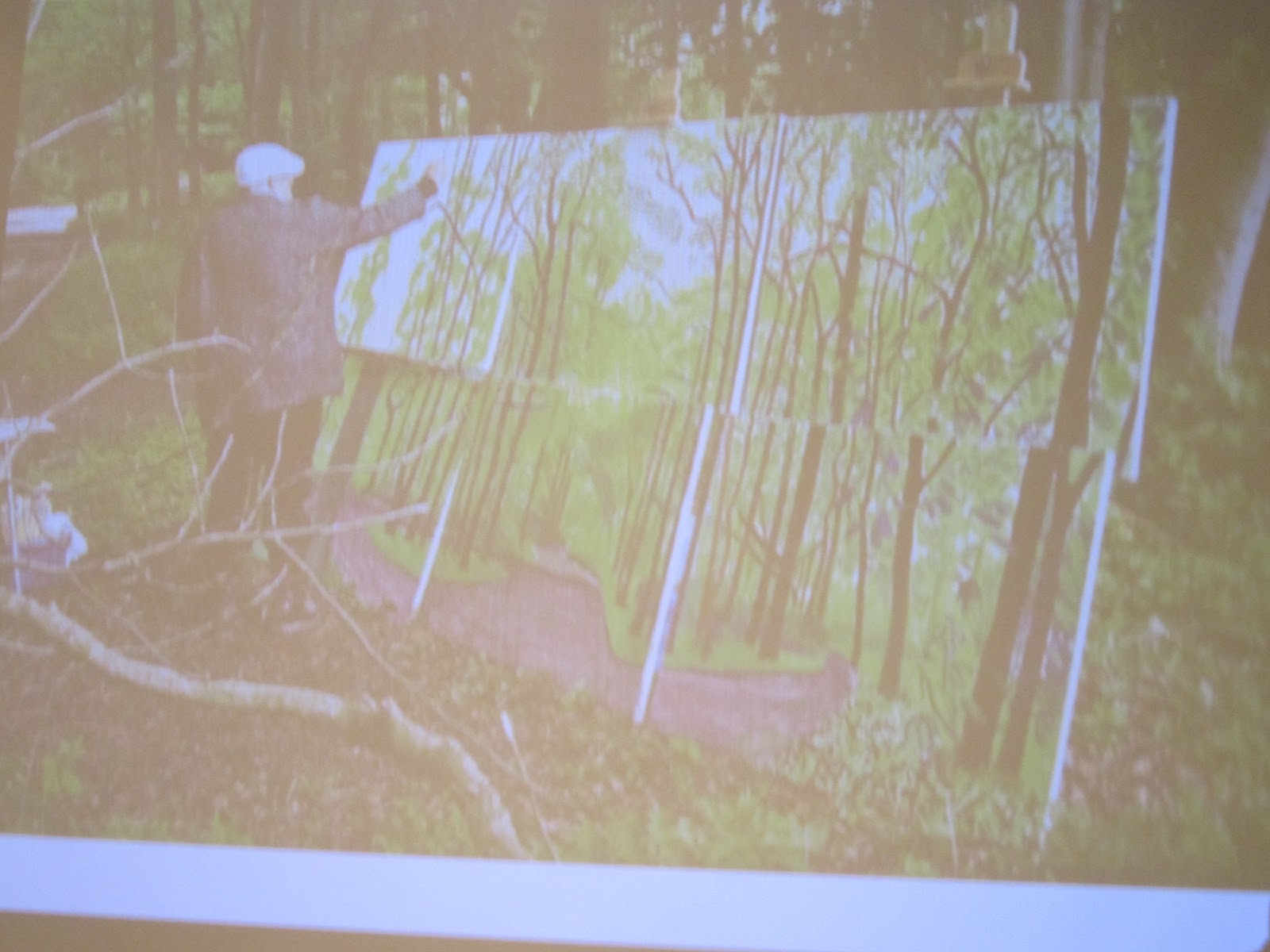
The format is the same as the previous Degas workshop that we attended.  It started with a 45-minute slide presentation about Hockney's life and work, the significant influences to his work, and his methodology.

Hockney in the Swinging 60s, when he was best known for his Pop Art.
Showing the scale of his latest work.
Looking at the 9 screens that show 9 different perspectives captured on 9 cameras.
The second part of the workshop was a 40-minute visit to the exhibition, guided by a friendly volunteer who shared with us her enthusiasm and knowledge of the major pieces of work on display.  I think it is important for Tiger to see actual pieces of art work, whenever possible, to see for himself the actual size of the work and how they are being done.  So far, the scale of Hockney's work in this particular exhibition is the largest that Tiger has actually seen in person.  There were also a few large-scale photocollage on display, which gave Tiger yet further ideas on the possibilities of manipulating visual images.

The final part of the workshop was another 45-minutes of hands-on activities, guided by instructions from the workshop leader.

The first activity was to work in charcoal to make landscape sketches in the style of Hockney.


The next activity was to use a combination of marker pens and chalk pastels to draw a landscape.  The twist to this simple exercise was that the workshop leader gave verbal 'instructions' in the form of a short poetry for the participants to follow and interpret in their own ways, using a variety of different marks.


The final exercise at the workshop was to create our own iPad paintings, as seen in the exhibition, by layering sheets of tracing paper on top of one another to create a multi-layered drawing.


Hockney is obviously a fan of iPad art, but I am not so sure about using the technology for anything more than quick sketches.  Then again, I tend to hold a more conservative view when it comes to art so make your own minds up about this.

Hands-on Project
After we got home, I asked Tiger what he found most interesting in the exhibition and he replied that he was fascinated by the photocollage he saw, specifically the Pearblossom Highway.  An image of this piece of work has been printed on the exhibition guide that I have, so we looked at it more closely to examine how it was done.

Once Tiger has understood the technique, I let him choose an image from the back issues of the National Geographic magazine we have.


Once he has decided on the image, he proceeded to cutting, arranging and gluing the various pieces.  This project took careful planning and execution so as not to mix the pieces up.


Tiger enjoyed putting the photocollage together.  It gave him a new way of looking at things.  He said looking at the collage made him feel dizzy:


This post is linked up to several blog hops, where you can visit to see what other homeschoolers have been busy with.  It is also linked to the Charlotte Mason Blog Carnival.

Thursday, 15 March 2012

It's all about timing

When it comes to formal writing lessons, Tiger has never been a big fan.  He tolerates them but will not do more than what is absolutely necessary for each lesson.  He finds the act of writing tedious on the physical level, and he often thinks much faster than he can get his ideas down on writing.  However, he loves to write short notes, messages, and lists so he does write something everyday outside of our formal lesson time.

In the past few months, Tiger has been writing in a notepad that he keeps by his bedside every morning.  On the few occasions when he showed me his notepad, I saw that he has been writing out one to two sentences about what he planned to do each day.  It was done entirely on his own account, so I was very encouraged to see him doing it.  In order not to squash his budding interest in writing, I did not correct any error in his notepad.

A few days ago, Tiger was in a particularly restless mood.  He was bouncing off the wall for the entire day, not feeling satisfied with any activity that we did.  By late afternoon, both of us were exhausted by his restlessness so I left him to entertain himself while I cooked dinner.  He got into his "time machine" (Tiger has been very interested in the concept of time and on the topic of time travel lately), and decided to keep a travelouge of his 3-day adventure in what he calls his "time car".

Title page: Adventures in the Time Car

When Tiger showed me what he has written, I suddenly had a brainwave: art journal!  I had thought about doing art journals with Tiger before, but it never came together because he was not ready for it.  Perhaps part of the reason it did not happen was because I might have turned it into an academic exercise -- I am much more relaxed these days about how Tiger learns.

After dinner, I asked Tiger whether he would be interested to try out art journaling.  I gave him a journal book that I had bought for him a few years ago when the journaling idea first came to me, but since that never happened the journal has been in the cupboard until now:

Tiger is a big fan of the Winnie-the-Pooh characters.
I then took out my own journal and said we would work alongside each other.  I think having me work together with him on this, at least at the start, has been very useful in a few ways:
  • Tiger does not see this as being yet another academic exercise that his mum-and-teacher is making him do;
  • he gets to see one example of how art journaling can be done;
  • he sees and experiences for himself that art journaling is a liberating and enjoyable activity.
So we got started.  In order not to overly complicate the process at the beginning, I just set out the dry materials (felt tips, markers, coloured pencils, and ballpoint pens).  I explained that there are basically no rules (yay!!) to art journaling, but to get us started I laid down a few simple guidelines:
  • use any materials;
  • write, draw, doodle, scribble, do whatever you fancy in the art journal;
  • it can be about anything, everything, or nothing at all;
  • it can be about feelings, facts, records, anything that you feel you want to put down on paper.
Once Tiger got started, he carried on page after page, and did not stop until he had completed 8 pages in his journal.  That took 45 minutes.  Wow, compare that with the 15 minutes of daily coaxing that happens in our writing lessons!  More importantly, he enjoyed the process so much that he did not want to stop and wanted to do it again the next day.


Our first session has been a huge success for us and we intend to do more of it together.  There is certainly a lot of potential to explore and much scope to expand into in this area.  For example, we might try a themed session next time, or include other media..... the possibilities are endless!


I have done very little mixed media work in the past, but trying out art journaling has sparked my curiosity and interest in this area.  Hence, for my own development, it would be very interesting to try out something new.  Even if it does not change my style (which I am sure it will, in some ways) it will at least give me a break from my own art making and training, which tend to lean towards the academic/serious side, and allow me to experiment and have more fun in art making.


This post is linked up to several blog hops, where you can visit to see what other homeschoolers have been busy with.  It is also linked to the Homeschool Showcase #94.

Monday, 12 March 2012

Who goes there?

When there was still snow on the ground, we spotted some mysterious footprints in the garden.


Very mysterious indeed.  Who could it have been?

The following morning, we ventured out to make some new prints of our own:


and to look for more interesting prints.  It was fascinating to see the different prints and trying to guess who/what else was around.


Most of the above were tracks of: foxes, rabbits, dogs, birds, roe deer, muntjac deer, fallow deer and red deer.

The most interesting tracks were the following, which we still cannot figure out how they were made.  At first I thought they looked like claw marks (from a badger?) but Tiger noticed that there were no footprints nearby.  Tiger thought they were whisker marks since they were so faint, almost weightless.  Mystery marks!


Other than making "wild guesses", we did some real work at home, using the really useful guide here to learn about the characteristics of tracks of animals from the same family group, as well as the types of trail that would be left behind by certain animals:


We found a related book to read.  Tiger also did some rubbing from a set of animal tracks plates that we have from a few years ago.  The book was interesting, but I am not sure of the value of doing those rubbings.  I guess we can glue them into the nature journal.


This post is linked up to several blog hops, where you can visit to see what other homeschoolers have been busy with. 
Friday, 9 March 2012

Lab session at the pet store

This week's science lesson required that Tiger observe a few small, live animals to compare and contrast their characteristics.  Armed with the record sheet, we headed to the pet store in town.

Since we are still studying vertebrate, we concentrated our observations on this group of animals.  The pet store is quite sizeable, so we were able to spend an hour there for our "lab" to look closely at three out of the five vertebrate groups: reptiles, mammals, and fish.

Bearded dragons

Rabbits

Guinea pigs

Fish
Prior to this lesson, I had taken for granted the observational skills required to look closely at things and to translate what we see into descriptive words.  This lesson gave us a good reminder of this very important scientific skill.

During the lesson, Tiger was challenged to take his observations further by thinking of the following questions:
  • Both rabbits and guinea pigs are furry, but is there any difference in their fur?
  • Fish don't have legs so how do they move along in the water?  Would legs be useful for an animal that lives in water all the time?
  • All the animals we saw, apart from fish, have four legs.  How are the positions of their legs different, and why are they positioned as such?  How does that affect the animal's movement?  Why is it necessary for that animal to move in that way?
  • Where are the animal's eyes positioned?  Why are they positioned as such?  Does the position affect their roles as either prey or predator?

This post is linked up to several blog hops, where you can visit to see what other homeschoolers have been busy with.  It is also linked to the Carnival of Homeschooling: The Balloon Dog Lessons edition.

Wednesday, 7 March 2012

On teaching art: post-workshop views

I finally attended the one-day creativity workshop that was initially to have taken place in November, but which I had to postpone attending due to Tiger's viral infection.  I signed up for this workshop with the aim to be more informed of the different ways to teach art and drawing, to widen my perception of creativity, and to learn from other art teachers.  The workshop met all of my objectives and more -- it has left me feeling stimulated and more confident about letting Tiger (and myself) explore seemingly unrelated avenues of artistic expression without worrying too much that Tiger is not yet ready to learn representational drawings.

The workshop room at lunch time.
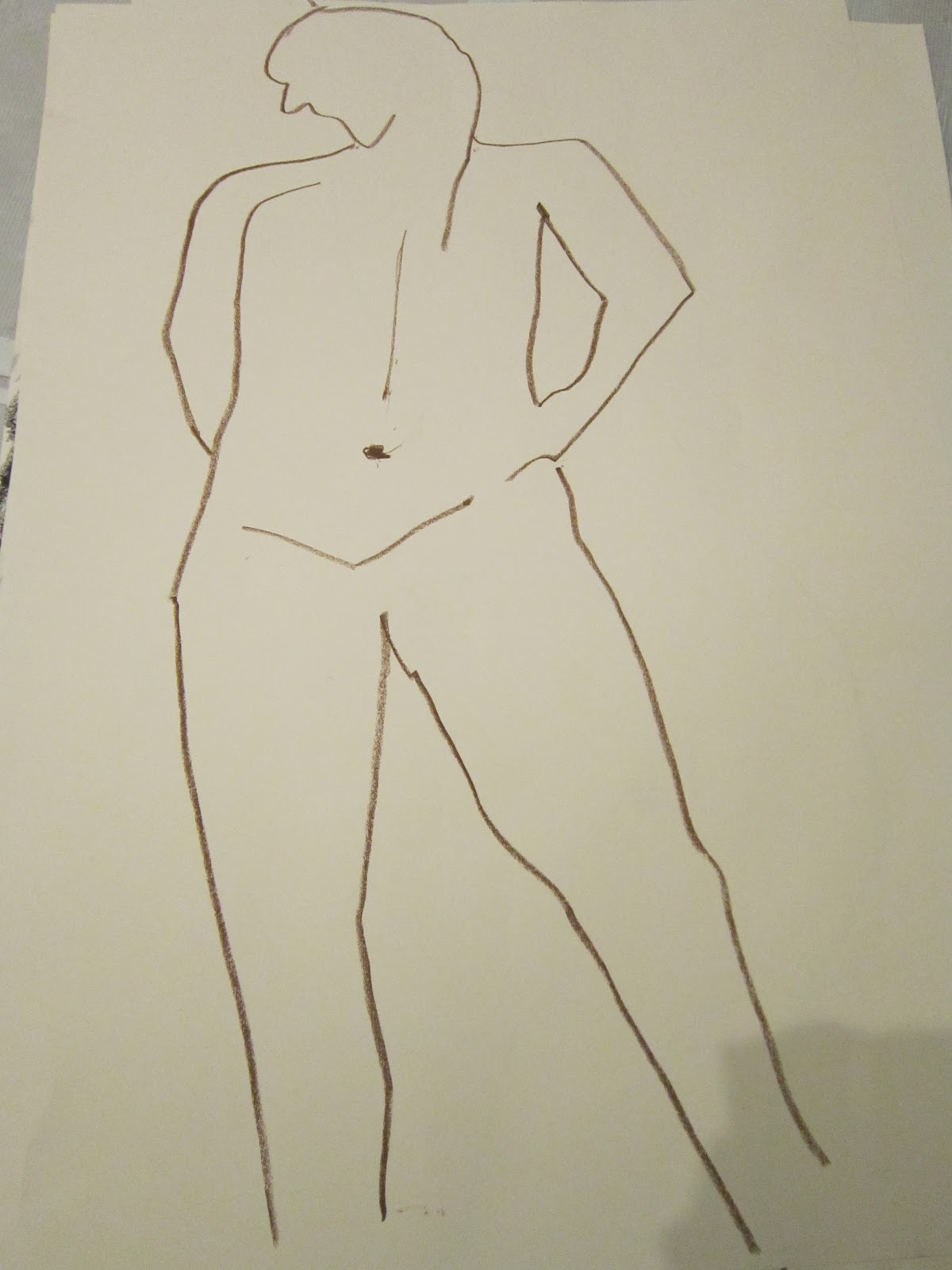
The workshop leader was a very experienced teacher-trainer and practising artist.  What a fantastic combination!  He not only gave us many thought-provoking exercises that helped us to get out of our comfort zones, for example (1) focusing on a single part of the life model and finding ways to represent the texture and (2) gradually reducing the number of strokes to represent one posture, but also validated an acceptance to the different styles of artistic expressions.

The following pieces of "family-friendly" work I did on that day give a good glimpse of my experience.

Close-up of the model's hand and foot.
An interpretation of a fellow participant's palm.
The life model.
Drawing with 10 lines.
The same pose in 3 lines.
The biggest learning points for me from the workshop are:
1) individual responses and interpretations of the same subject are different and valid, as long as the finished work is what the artist want to convey;
2) it is perhaps more important for the artist to connect with his/her subject and convey that connection down on paper (which is then conveyed to the audience viewing the final work), rather than being technically perfect but disconnected;
3) connectivity needs to be borned out of freedom of expression;
4) technical perfection is helpful but can hinder the artist's expression if he/she becomes too rigid about technicalities;
5) different forms of artistic exercises and ideas can increase the development in another art form -- creativity can 'cross-pollinate'.

Before attending the workshop, I wondered whether I ought to introduce formal drawing lessons to Tiger so that he can "draw better".  Having attended the workshop, I no longer worry about this.  We do a lot of visual art at home, and I am now reassured that each activity forms a different experience for Tiger which has a cumulative effect on how he chooses to express himself.  We can afford to wait a few more years for Tiger's fine motor skills and ability to concentrate for longer periods of time to develop, so that he may then learn formal drawing skills in the most effective way.

My pre-workshop views are in On Teaching Art: Pre-workshop Views.


This post is linked up to several blog hops, where you can visit to see what other homeschoolers have been busy with.

Friday, 2 March 2012

The image of a mother

I could not stop laughing when I read about the interaction between a mother and her offspring here.  Seriously, I am not always like this, even though Tiger would have you think otherwise.  Most of the time I actually look like this:


I'm not that scary, really.
Related Posts Plugin for WordPress, Blogger...